

RCBOs vs Two Main RCCBs: Why Bahrain Should Catch Up
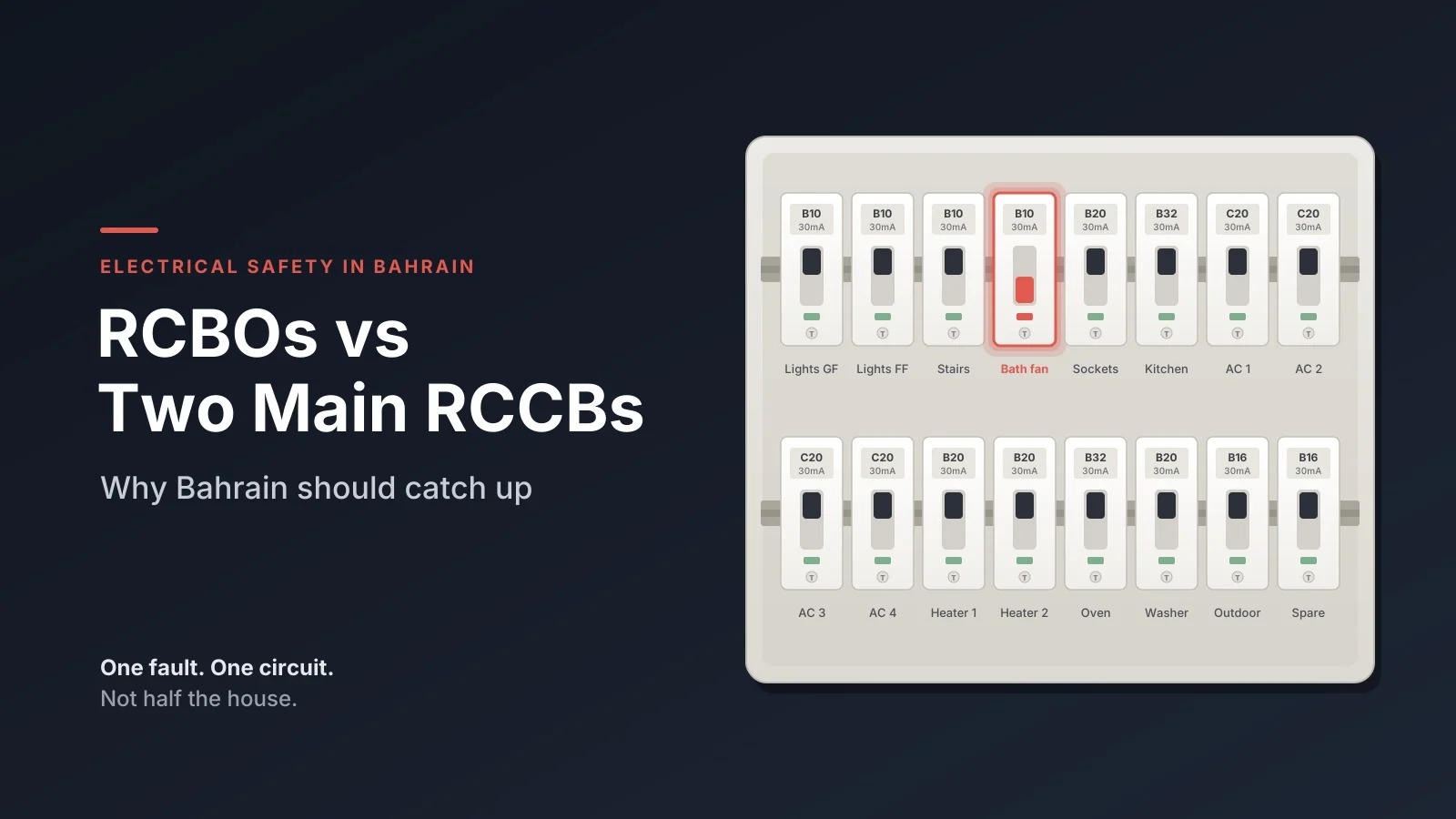
Two RCCBs for the whole house is no longer good enough
Most villas and flats in Bahrain are still wired the way the UK wired them in the 1990s: a main switch, two residual current circuit breakers (RCCBs) and a row of miniature circuit breakers (MCBs). One RCCB is labelled "lighting" and carries every lighting circuit in the house, usually with the exhaust fans and often an AC unit or a socket circuit added later; the other is labelled "power" and feeds the kitchen appliances and sockets. Every earth fault on the lighting side, from a damp bathroom fan to a condensate leak in an AC unit, passes through that one RCCB, and when it trips every light in the house goes out at once.
This article argues that every final circuit should instead have its own residual current breaker with overcurrent protection (RCBO). The UK has moved this way since its 18th Edition wiring regulations, and several European codes now cap how many circuits may share one RCCB. The extra cost is real but small next to what it buys: protection that stays on, faults that identify themselves, and no temptation to bypass a device that trips too often. Where I write in the first person, the examples come from my own work on homes in Bahrain.
A note on names: the RCCB (residual current circuit breaker) is the device found on most Bahraini boards. BS 7671 calls the family residual current devices (RCDs) and the EWA regulations call them earth leakage circuit breakers (ELCBs); this article uses RCCB and keeps the other names only where a regulation is quoted.
What each device actually protects
An MCB protects the cable; an RCCB protects the person. Neither can do the other's job, and a 20 A MCB will never notice the 30 mA that can stop a heart. An RCBO simply puts both functions in one device, on one circuit.
Device | Trips on | What it protects | What it cannot see |
|---|---|---|---|
MCB (miniature circuit breaker) | Overload and short circuit, roughly 1.45× to 10× its rating | Cable insulation and the board, against overheating and fire | A shock current of 30 mA, which is 0.15% of a 20 A rating |
RCCB (residual current circuit breaker; an RCD in BS 7671, an ELCB in the EWA regulations) | An imbalance of 30 mA or more between live and neutral, cleared within 300 ms | People touching a live fault, and fires started by small earth leakage | Overload or short circuit; it relies on MCBs for that |
RCBO | Both of the above, on one final circuit | Cable and person, circuit by circuit | Nothing the other two see; the trade-offs are price and board width |
In Bahrain the RCCB carries more weight than in the UK. The EWA specifies a TT earthing system, in which the earth-fault path runs through the ground rather than back along the supply cable. In TT systems an earth fault often cannot push enough current to trip an MCB quickly, so the RCCB is the main line of defense against electrocution, not a backup.
Five ways the two-RCCB board fails the household
Two RCCB, one for lighting and one for power, are the cheapest way to satisfy the rules, and the arrangement fails in five predictable ways. None of them is a defect in the device; they are consequences of putting eight or more circuits behind each trip, sorted by label rather than by risk.
One fault, every light out. The lighting RCCB carries every lighting circuit in the house, plus whatever else was wired to it: the exhaust fans, sometimes an AC unit or a socket circuit. A damp bathroom fan or a condensate leak in an AC unit takes out the stair lights, the bedroom lights and the fans at the same time. Losing the lighting during a fault is itself a hazard, which is why BS 7671 Regulation 314.1 requires an installation to be divided into circuits so that a single fault does not remove supply from groups of circuits.
Standing leakage adds up until it trips for no fault. Every inverter AC unit, LED driver, computer and induction hob leaks a little current to earth through its filter; product standards allow a fixed Class I appliance up to 3.5 mA. BS 7671 Regulation 531.3.2 says the standing leakage downstream of an RCCB should not exceed 30% of its rating, which is 9 mA for a 30 mA device. Three large appliances can reach that before anything is wrong, and a lighting RCCB carrying several AC units and a hundred downlights is well past it. There is nothing broken to find, which is what makes the next step so tempting.
Nuisance tripping invites a dangerous fix. In my work this is a familiar day: the RCCB trips, the whole day goes into tracing the fault, and at the end there is no fault at all, only leakage from several large appliances stacking up until it crosses the threshold. That is the moment the 30 mA device gets swapped for a 100 mA or 300 mA one, which EWA Regulation 612 permits for lighting, AC and heater circuits, or bypassed altogether. Either removes the 30 mA protection from every socket and fan on that RCCB, and nobody sees the change from the outside of the board.
The trip tells you nothing. One trip, eight or more suspects. This is the call we get most often: the RCCB has tripped and nobody knows which circuit is behind it. In one typical case it was a worn-out socket whose wiring had started leaking current to earth. Finding it means switching off every MCB on that side and re-energizing them one at a time, usually in the dark and usually by someone who is not an electrician. It is slowest when the RCCB trips five minutes after being reset rather than immediately, because every circuit has to stay on long enough to prove it is not the one.
Two points of failure, with no warning. RCCB mechanisms stick, which is why every one carries a "test quarterly" label. The RCCBs I have tested myself have worked, but almost nobody presses that button, and I would bet a large number of boards in Bahrain have one that no longer trips. If the lighting RCCB seizes, half the house loses shock protection at once and nothing on the board shows it. With a device per circuit, one failure affects one circuit.
The EWA already recognizes the principle for buildings with several tenants: Regulation 613 says one customer's earth-leakage trip must not interrupt another customer's supply. Inside a single home, the same logic applies to the bedroom lights and the bathroom fan.
A case from the field
One of our emergency calls came from a client whose home automation we had installed; the electrical installation itself was someone else's work. The lighting on one whole floor kept tripping, and he assumed our system was the cause. We had a good idea of the problem before we arrived, because we had already seen his DB: the typical board, with one RCCB carrying the floor's lighting and more besides.
He was not convinced at first. Once we found the breaker that was leaking current and replaced it with the spare in the board, the tripping stopped, and so did the argument. With an RCBO on that circuit, the first trip would have pointed straight at the fault, and nobody would have suspected the automation.
What changes with an RCBO on every circuit
An RCBO is an MCB and a 30 mA RCCB in one module, so each final circuit carries its own earth-leakage trip. The physics of the protection does not change; what changes is how much of the house each fault can take with it.
A fault isolates one circuit. The bathroom fan trips and the lights stay on. Circuits that must not drop, such as the fridge, the alarm or a home-dialysis machine, are no longer hostage to the garden socket.
The leakage budget is per circuit, not per label. The 9 mA ceiling now applies to the appliances on one circuit, so standing leakage from a houseful of inverter AC units and LED drivers stops causing trips. This is the solution BS 7671 Regulation 531.3.2 points to.
The tripped handle names the fault. The device that dropped is labelled "Kitchen sockets" or "Master bathroom heater". Diagnosis takes seconds instead of an evening, and the household can reset everything else immediately.
Failure is contained and testable. Each RCBO has its own test button, and a seized mechanism leaves one circuit unprotected rather than eight.
Selectivity comes for free. Nothing upstream needs to discriminate with the 30 mA devices. If a 300 mA time-delayed RCCB is wanted at the incomer for fire protection on an outbuilding feeder, it coordinates naturally with the RCBOs below it.
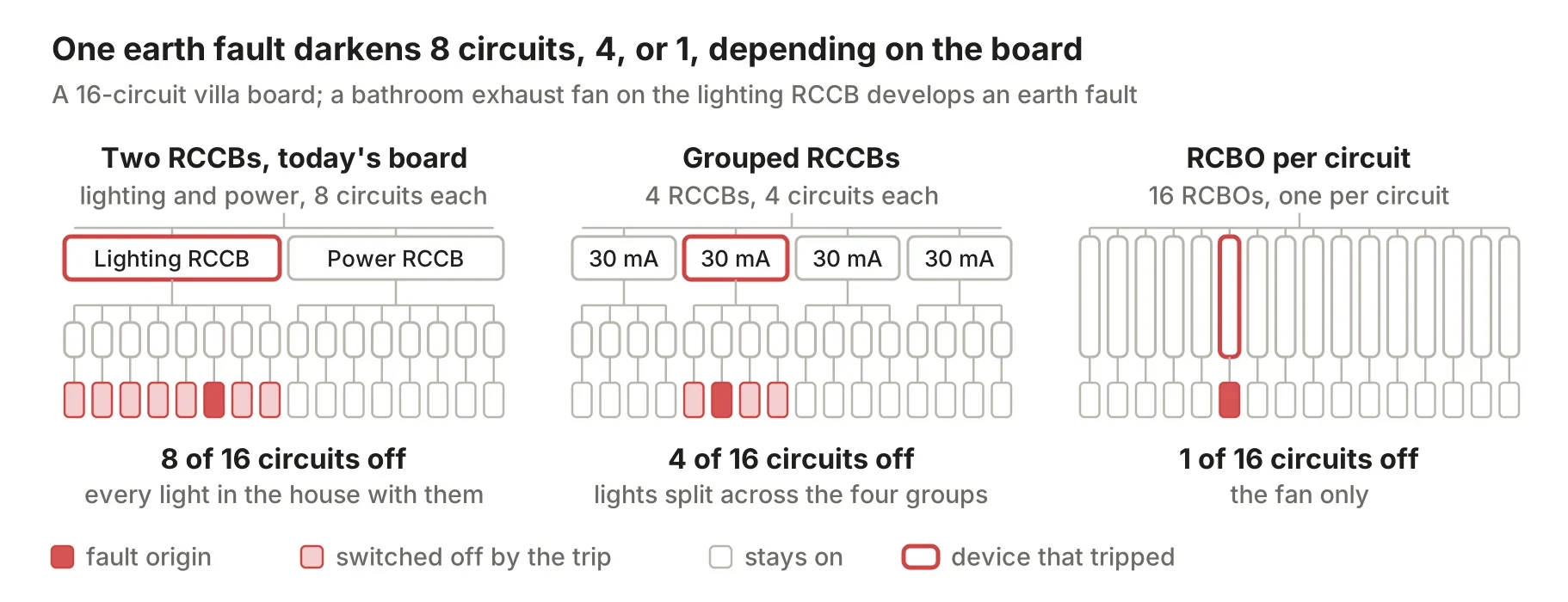
The same fault on the same 16 circuits: the lighting RCCB removes half the house and every light in it, four grouped RCCBs remove a quarter, and an RCBO removes only the fan.
Where Europe and the UK have gone
No major code outside the Gulf still accepts one or two 30 mA devices for a whole dwelling. The UK got there by tightening the rules on unwanted tripping until RCBOs became the practical answer; the Netherlands, France and Australia got there by capping how many circuits may share one RCCB.
Code | 30 mA protection required on | Circuits per 30 mA device | Minimum devices | Key dates |
|---|---|---|---|---|
All sockets up to 32 A, all domestic lighting circuits (Reg. 411.3.4), cables buried less than 50 mm in walls | No fixed cap, but Reg. 314.1 and the 9 mA leakage limit in Reg. 531.3.2 make per-circuit RCBOs the normal design | None fixed; manufacturers report an accelerating move away from dual-ELCB boards | 2008 sockets, 2018 lighting, 2022 dwelling exemptions removed | |
Netherlands, NEN 1010:2020 | All final circuits in dwellings | Maximum 4 | At least 2 | Expected leakage capped at 0.3 × rating (9 mA) |
France, NF C 15-100 | Every circuit in the dwelling | Maximum 8 | At least 2, lighting and sockets split across them | 30 mA on all socket circuits since 1991 |
Australia and NZ, AS/NZS 3000:2018 | All final sub-circuits in dwellings | Maximum 3 | At least 2 in Western Australia, lighting split between them (Reg. 12A) | 2018; WA makes it a legal condition of selling a house |
Dubai, DEWA 2017 | Sockets up to 20 A, every water-heater circuit, outdoor equipment, cables less than 50 mm in walls | No cap; socket circuits grouped in their own 30 mA section, cookers on a 100 mA device | Split board implied | 2017, based on the 17th Edition |
Bahrain, EWA Regulations | Sockets and domestic appliances at 30 mA; lighting, AC and heaters allowed up to 300 mA (Reg. 612) | No cap; "one or more" ELCBs (Reg. 611); subdivision permitted for selectivity (Reg. 409) | 1 required; 2 in practice (lighting and power) | Based on the 16th Edition (1991–2001) |
The UK route is the most instructive because its starting point was Bahrain's board today. The 17th Edition (2008) put 30 mA protection on every socket, and the industry answered with the dual-RCD split board: two RCCBs with a group of circuits behind each, the same lighting-and-power arrangement found in Bahraini villas.
Nuisance tripping and whole-group blackouts followed, so the 18th Edition (2018) added Regulation 531.3.2 on unwanted tripping and extended protection to lighting. "Electrium", one of the large UK board makers, now describes the dual-RCD unit as unable to keep healthy circuits alive when one circuit in the group faults, and the IET's guidance names individual RCBOs as the design that satisfies Regulation 314.1.
Where Bahrain and the Gulf stand
Bahrain's wiring rules are not wrong; they are old, and they set the floor at one device. The EWA's Regulations for Electrical Installations state in their preface that they draw on the 16th Edition of the IEE Wiring Regulations, a book the UK replaced in 2008 and again in 2018. Regulation 611 asks for "one or more" earth-leakage circuit breakers, and the usual Bahraini board stops at two: one labelled lighting, one labelled power, with eight or more circuits behind each.
The regulations already leave the door open. Regulation 409 says earth-leakage protection "may be sub-divided" onto the outgoing ways for selectivity, with the incomer's RCD then omitted. Regulation 718-2 requires a circuit schedule in Arabic and English on every board, which only becomes useful to a householder when the device that trips is the one named on the schedule. And Bahrain's standards body has adopted the IEC product standards for RCBOs (the BH GSO IEC 62873 series, 2022, and IEC TR 60755, 2024), so the devices themselves are recognized; it is the installation practice that has not moved.
The Gulf's conditions make the case stronger than Europe's, not weaker:
Humidity and condensation. The EWA's own climate clause (Regulation 301) allows for relative humidity reaching 100%. Condensation on AC drain trays, outdoor units, bathroom fans and garden sockets is the most common source of the small earth leakages that trip a 30 mA device.
Many AC units per home. A villa typically runs six to ten split units, each an inverter with an EMC filter that leaks a little to earth by design, and they are often wired to the lighting RCCB. On a shared RCCB that leakage is summed; on RCBOs it is divided.
A water heater in every bathroom. The EWA requires every storage heater on its own circuit with 30 mA protection (Regulation 902-4). Immersed elements scale and corrode in Gulf water and are the classic cause of a trip; on a shared RCCB, a failing heater in a guest bathroom switches off every other circuit on that device.
Losing AC in August is a health risk. A whole-side trip at 2 a.m. in summer, in a house with an elderly relative or an infant, is not an inconvenience. It is the kind of danger Regulation 314.1 of BS 7671 was written to prevent.
What it costs
An RCBO costs more than the MCB it replaces, so a board with an RCBO on every circuit costs more than today's two-RCCB board; splitting the circuits across four smaller RCCB groups adds only a little. Next to the cost of building or renovating a villa, the RCBO premium is a small fraction, and it is paid once.
Against that premium, set what a shared RCCB costs every time it trips: an electrician's call-out to trace the fault, a freezer of spoiled food, a night without lights or air conditioning, and the quiet risk that someone "fixes" the problem by removing the protection. The grouped-RCCB board is the cheapest meaningful improvement on a retrofit; the RCBO board is the design new villas should be built to.
In my experience, clients rarely see the point of an RCBO on every circuit when they first read the quote. Once the difference is explained, what an RCBO can detect and protect against that a shared RCCB cannot, and what it means day to day when one fault no longer darkens half the house, the price difference stops being a big deal.
What should change, and who should change it
Homeowners building or renovating
Ask for a 30 mA RCBO on every final circuit and have it written into the DB schedule. Expect it to add a few hundred dinars at most on a villa.
On an existing board that cannot be replaced, split the circuits across several 30 mA RCCBs, no more than four per device, with the lighting divided between at least two. Move the water heaters, bathroom fans and outdoor circuits onto their own RCBOs first; they are the usual culprits.
Never accept a 100 mA or 300 mA device, or a wire link, as the fix for an RCCB that keeps tripping. The tripping is the symptom; the fix is to find the leak and to divide the circuits.
Choose Type A devices for circuits feeding inverter AC units and EV chargers, and press every test button once a quarter.
Contractors and consultants
Make RCBO-per-circuit the default on new domestic DB schedules. Regulation 409 already permits the incomer RCCB to be omitted when protection is subdivided onto the outgoing ways.
Design the leakage budget per circuit and keep each one under 9 mA, following BS 7671 Regulation 531.3.2.
Label every way in Arabic and English, as Regulation 718-2 requires, so that the device that trips tells the householder what to check.
The EWA and the GCC standards bodies
Bring the Regulations for Electrical Installations up to the 18th Edition baseline: 30 mA protection on lighting circuits, a cap on the number of circuits per 30 mA device, lighting split across at least two devices, and the RCBO named as the preferred arrangement for dwellings.
Make these a condition of the connection inspection.
Bahrain has already adopted the IEC product standards for RCBOs through GSO. A matching GSO installation rule would let the whole Gulf move together instead of utility by utility.
If it were up to me, the rule would be simpler still: an RCBO on every final circuit as a requirement, not a recommendation, and old two-RCCB boards replaced with new ones rather than left in place under the exemption that Regulation 106 gives existing installations.
Two RCCBs, one for lighting and one for power, were a reasonable answer when the EWA regulations were written and every home had a dozen resistive loads. A Bahraini villa today runs inverter compressors, LED drivers, induction hobs and chargers around the clock, in 100% humidity, on a TT earth. The protection should be divided the way the loads are.
The UK, the Netherlands, France and Australia have each reached that conclusion by a different road; the cost of following them is the price of sixteen breakers.
For your own safety: go to your board today and press the test button on each RCCB. If it does not trip, it is not protecting anyone in the house and is a safety hazard in itself; have an electrician replace it.
Sources
- EWA, Regulations for Electrical Installations, Kingdom of Bahrain — preface (16th Edition basis), Regs. 106, 301, 303, 409, 611–613, 718-2, 900-5, 902-4
- BH GSO IEC 62873-1:2022, RCD standards framework (RCCB, RCBO)
- BH GSO IEC TR 60755:2024, Bahrain Standards and Metrology Directorate
- Electrium / Voltimum, 5 things you need to know about Amendment 2 — Reg. 411.3.3 redraft, move away from dual-RCD units
- Hager, An overview of 18th Edition Amendment 2
- Trade Skills 4U, 18th Edition changes — Reg. 411.3.4 lighting circuits in dwellings
- Electrical Review, RCDs and the 18th Edition — Regs. 314.1 and 531.3.2, RCBOs as the compliant design
- Professional Electrician, Residual Current Devices: where should they be used? — 30% leakage rule, selectivity
- IET Wiring Matters, Mythbusters #8 (July 2022) — Reg. 314.1(iv) text
- Techniek Nederland, Nieuw in norm NEN 1010:2020 (webinar, Oct 2021) — max 4 circuits per 30 mA RCD, 0.3 × IΔn leakage
- Legrand France, Combien faut-il mettre d'interrupteurs différentiels and 123elec, Norme protection différentielle — NF C 15-100: min 2 devices, max 8 circuits e
- 123elec, Norme protection différentielle — NF C 15-100: min 2 devices, max 8 circuits each, 1991
- Electricity Regulations 1947, Reg. 12A
- Field examples in the first person: the author's own site work in Bahrain
Comments
Be the first to comment.
Questions about this article
What is the difference between an MCB, an RCCB and an RCBO?
An MCB trips on overload and short circuit, so it protects the cable. An RCCB trips when 30 mA or more leaks to earth, so it protects people, but it has no overload protection. An RCBO does both jobs, in one device, for one circuit.
Does the EWA require an RCBO on every circuit?
Not today. The EWA regulations require earth-leakage protection by "one or more" devices, with 30 mA for sockets and appliances and up to 300 mA allowed for lighting and AC. An RCBO on every circuit goes beyond that minimum, and Regulation 409 already allows earth-leakage protection to be split onto the outgoing circuits.
What is wrong with the usual two-RCCB board in Bahraini homes?
Every lighting circuit sits behind one RCCB, so a single fault, such as a damp bathroom fan, can switch off all the lights at once. It also hides which circuit faulted, and one seized RCCB leaves half the house without shock protection.
Why does my RCCB keep tripping when no fault can be found?
Most likely, the small leakage currents of many appliances are adding up. Inverter AC units, LED drivers, computers and induction hobs all leak a little to earth by design, and BS 7671 advises keeping the total under 9 mA on a 30 mA device. Spreading the circuits across RCBOs divides that leakage instead of stacking it.
How do I test my RCCB or RCBO, and how often?
Press the button marked T. The device should trip straight away; then switch it back on. Do it every three months, and warn the household first, because the circuits behind it will go off. If it does not trip, call a licensed electrician to replace it.
Can RCBOs be fitted to my existing board?
Often, yes, if the enclosure has space and the RCBOs match the board's busbar system. Many RCBOs are twice the width of an MCB, so an older, full board may need replacing. Start with the water heaters, bathroom fans, AC units and outdoor circuits, and have a licensed electrical contractor do the work, as EWA Regulation 312 requires.
Is a board with an RCBO on every circuit much more expensive?
The board itself costs more, because each RCBO costs more than the MCB it replaces. But the board is a small part of what a villa's electrical work costs, and the premium is paid once, while a shared RCCB keeps costing you every time it trips: call-outs, lost hours, spoiled food and nights without AC. If the budget is tight, splitting the circuits across more RCCBs gets part of the benefit for a small extra cost.
Planning a project?
Talk to our engineers about lighting, control and automation for your space.