
Modern Lighting: Watts vs. Lumens and Why It Matters
 Ali Ebrahim Abbas29 Oct 2026 · 3 min read
Understanding Modern Lighting Standards: The Difference Between Watts and Lumens and How It Affects Your Bill
Lighting is one of the most important elements of interior design and everyday comfort at home, whether you are preparing your "forever home," refreshing the lighting in your majlis, or simply looking for a basic bulb for your room.But when you head to the local market, what is the first question you ask the salesperson? Most of us ask the traditional one: "How many watts (Watt) is this light?"For many years, a mistaken idea has stuck in people's minds: that "higher wattage means stronger light." Is that true in the world of modern lighting?The truth is that this rule used to apply to old (tungsten) bulbs, but it no longer applies at all to modern LED technology. Understanding the difference between the watt (Watt) and the lumen (Lumen) is the real key to getting excellent lighting while achieving tangible savings on your electricity bill.
The Key Difference: Energy Consumption vs. Light Brightness
To get the concepts right when choosing lighting for your home, you need to clearly separate the amount of electricity consumed from the amount of light produced:
1. What Is a "Watt" Really?
The watt is not a measure of light intensity, as many people believe. It is simply a unit for measuring electrical energy consumption.
• The higher the wattage, the more electricity is consumed, and the higher your monthly bill.
• With old bulbs, the manufacturer needed more electricity (higher wattage) to produce brighter light, which led people to wrongly link wattage with light output.
2. What Is a "Lumen" (Lumen)?
The lumen is the true, actual measure of how bright and powerful a light is.
• Higher lumens = brighter, stronger light.
• Lower lumens = dimmer, softer light.
A simple way to remember:• Watt (Watt): How much electricity does the light consume? (Cost)• Lumen (Lumen): How much light does it give you? (Intensity) |
LED Efficiency and Electricity Savings
With the modern shift toward LED technology, you can now get very powerful lighting while consuming very little electricity.
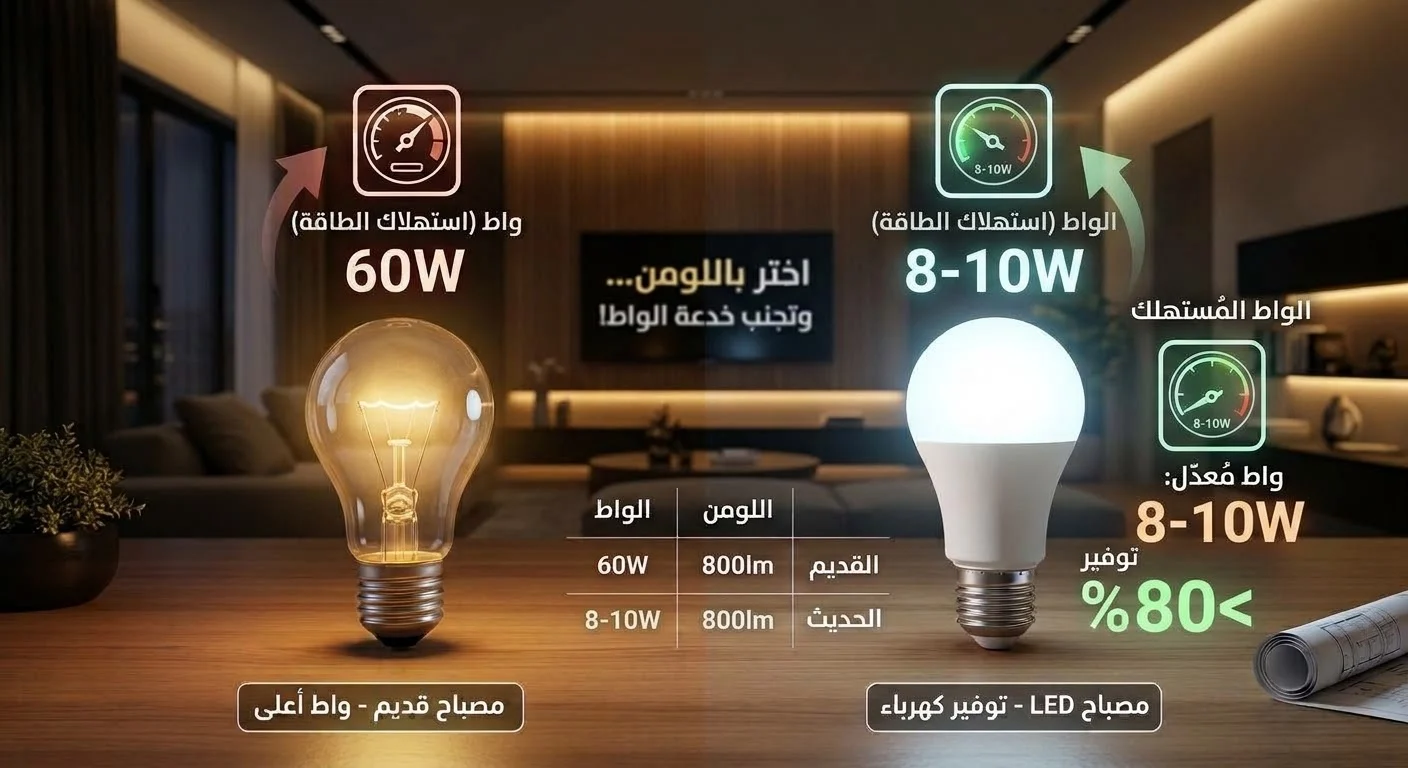
Savings | Light Output (Lumens) | Power Required (Watts) | Bulb Type |
|---|---|---|---|
- | 800 lm | 60 W | Traditional old bulb (Incandescent) |
More than 80% | 800 lm | 8 - 10 W | Modern LED bulb |
This comparison shows that you get exactly the same lighting power and brightness, but with electricity savings of more than 80% when you choose LED!
Practical Guidelines for Choosing the Right Lighting for Your Home
The next time you shop for lighting, follow these smart tips:
1. Look for "Lumen" or "lm" on the box: Instead of asking the salesperson "How many watts is this light?", ask directly: "How many lumens does this bulb give me?"
2. A quick guide to how many lumens each room needs:
• Soft, calm lighting (bedrooms, corridors): 400 - 800 LUX.
• Medium lighting (living areas, kitchens): 1000 - 1500 LUX.
• Very bright lighting (majlis, home offices): 2000 LUX and above.
3. The golden rule (highest lumens for the lowest watts): When comparing different products and brands, the better and higher-quality bulb is the one that gives you the highest lumen figure (brighter light) for the lowest wattage (lower electricity consumption).
Conclusion: Choose Wisely and Save on Your Bill
Being aware of these simple differences directly helps reduce energy consumption in our homes, conserve resources, and cut monthly electricity costs, without giving up strong, eye-friendly lighting.
The next time you buy a new bulb, always remember: choose by lumens, and don't be fooled by watts!
Comments
Be the first to comment.
Planning a project?
Talk to our engineers about lighting, control and automation for your space.