

Lumens, Lux and Kelvin: Stop Mixing Them Up
 Moaath Al-Bukaai21 Oct 2026 · 8 min read
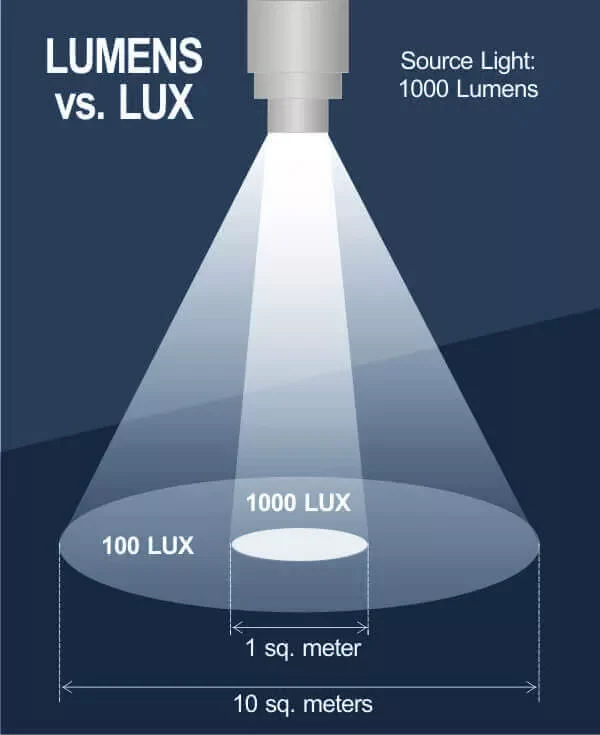
Three words everyone uses and almost everyone gets wrong. Here is how I explain them, with a garden hose.
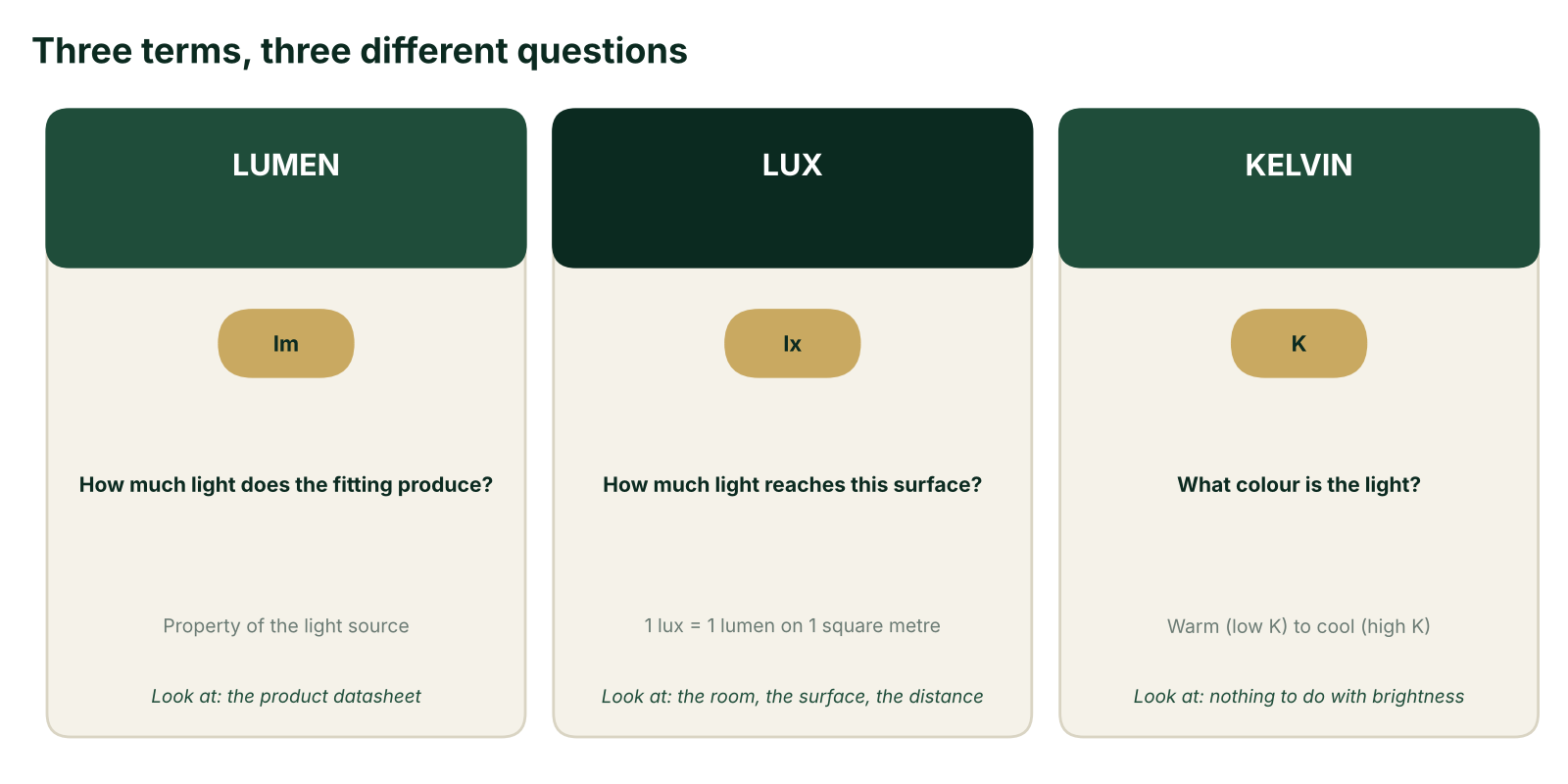
Lumens, lux and Kelvin sit on every lighting datasheet, and people swap them all the time. "More Kelvin" gets asked for when someone means "brighter", and that is not what Kelvin does. The result is rooms that are too dim, too blue, or lit by the wrong fitting. So let me clear this up in plain words. Three terms, three different questions.
Think of a garden
This is the picture I use, and it explains more than any formula.
Imagine watering a garden with a hose.
Lumens are the water coming out of the tap. It is the total amount the source puts out. It belongs to the fitting.
The beam angle is the nozzle. Narrow and it shoots a tight jet. Wide and it sprays a broad shower.
Lux is the water that actually lands on the plant. It is what the surface receives.
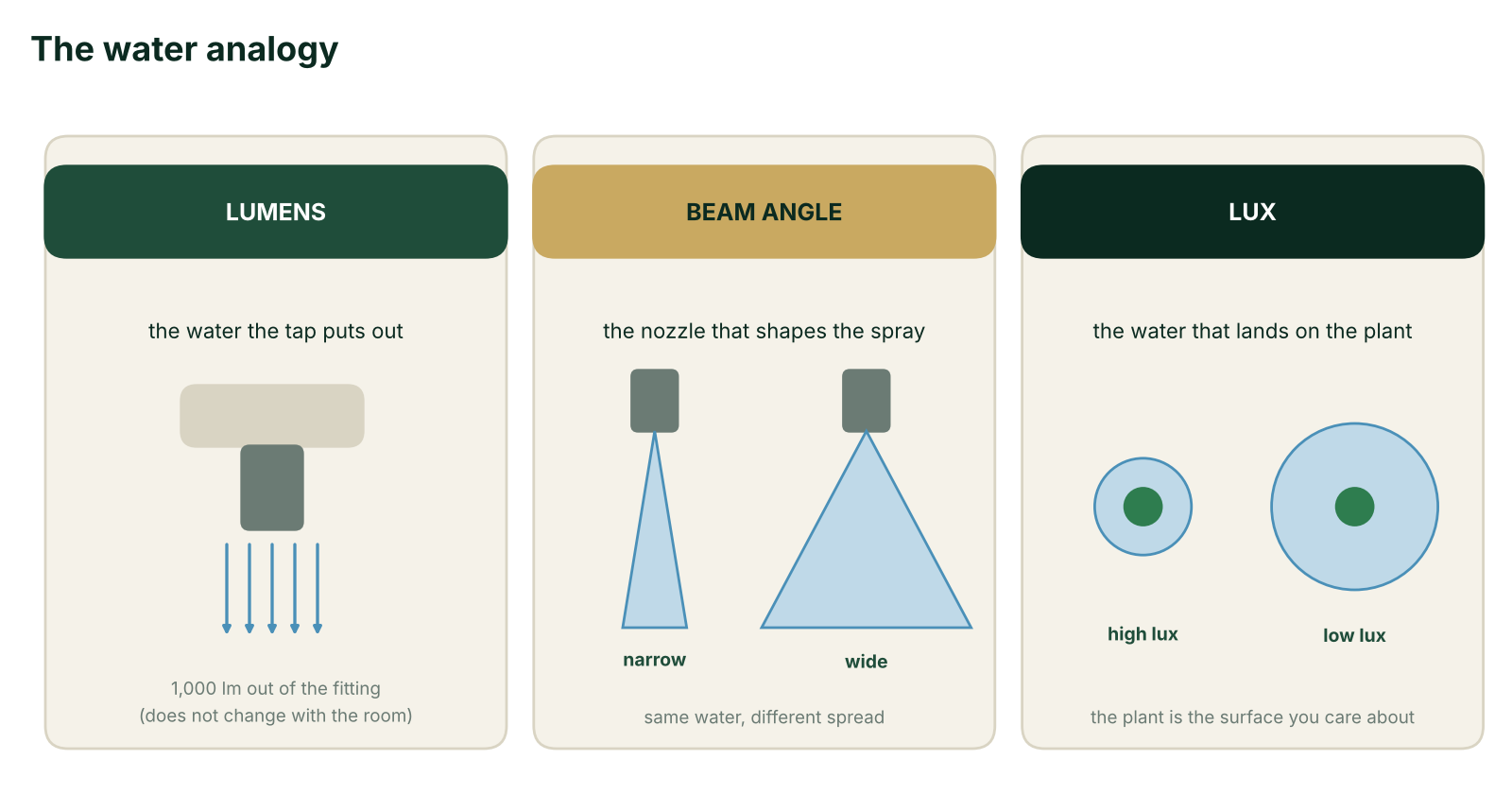
Here is the part people miss. The amount of water leaving the tap is not the amount your plant gets. Some of the spray bounces onto the other plants and the soil. It is not wasted, it just does not hit the target you aimed at. Light does the same thing: it hits the floor, the walls and the ceiling, and bounces around the room.
And the nozzle matters as much as the tap. Use the same water with a tight nozzle and one plant gets soaked. Switch to a wide spray and the water is spread over the whole bed, so each plant gets only a little. Same water, very different result. That is exactly what a beam angle does to light.
Lumens: how much light the fitting makes
A lumen measures the total light output of a source. Bigger number, more light leaving the fitting. It tells you nothing about how bright your table will look, because that depends on where the light goes.
Lux: how much light reaches the surface
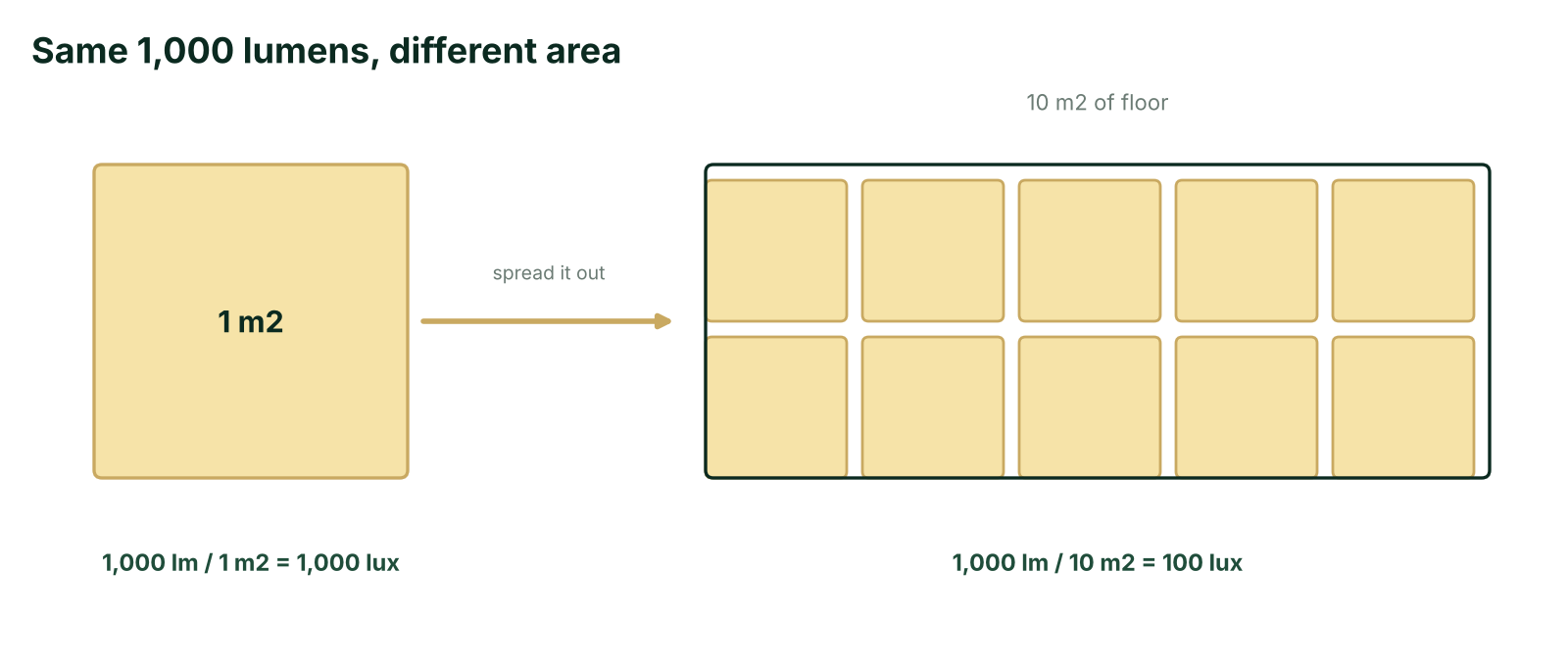
1 lux is 1 lumen landing on 1 square metre. Spread the same light over a bigger area and the lux drops. According to Wikipedia's lux page, 1,000 lumens on 1 m² gives 1,000 lux, and the same 1,000 lumens spread over 10 m² gives only 100 lux.
Now the nozzle. Take one 1,000 lumen fitting and change only the beam angle. At 2.5 metres, straight below, in an idealised even beam:
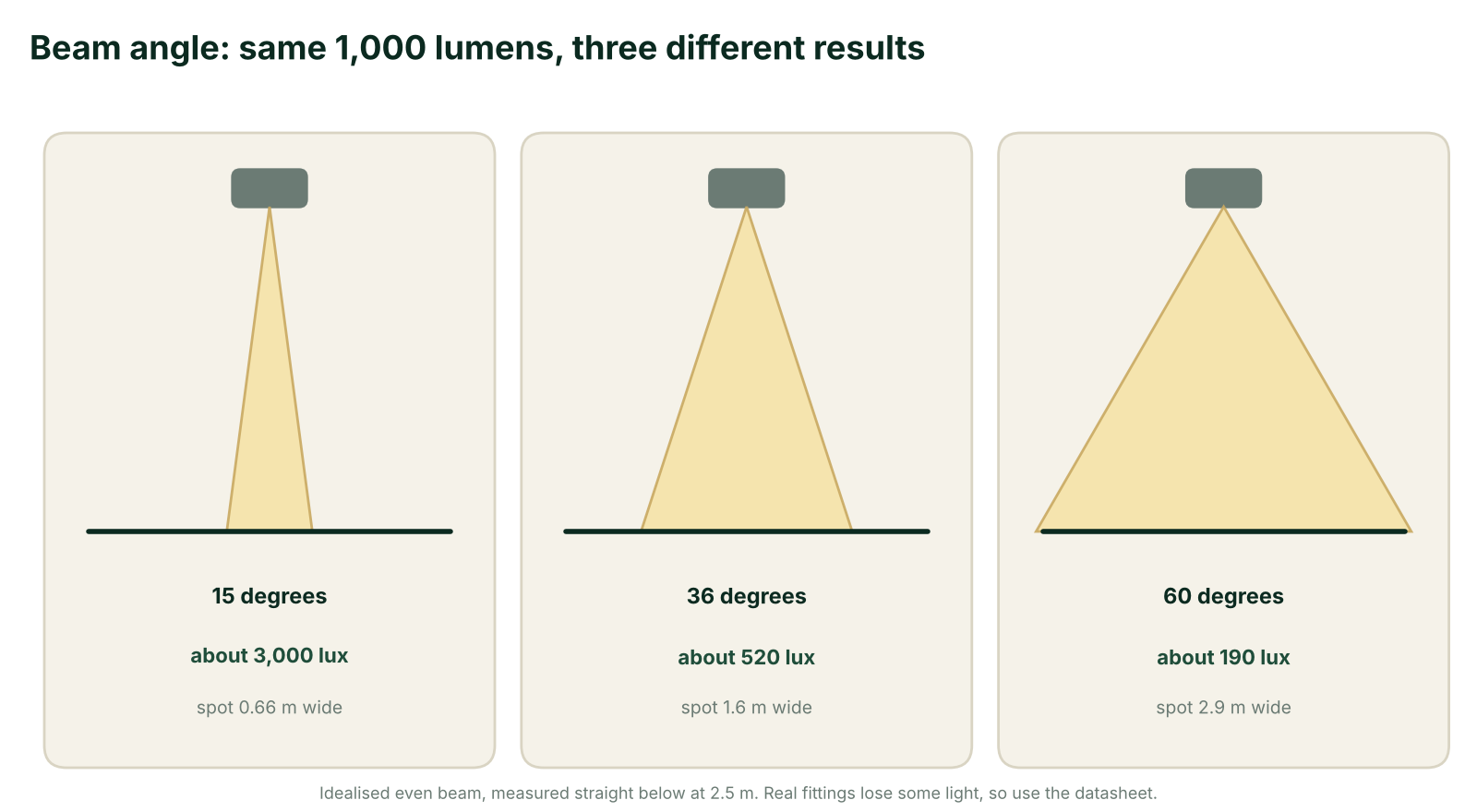
Same lumens, about 16 times more lux from the tightest beam than from the widest. That is why a spotlight can make a painting glow while a wide flood barely lights the wall, with exactly the same number on the box.
Real fittings lose some light and beams are not perfectly even, so always read the photometric data. This example is my own arithmetic to show the idea, not a product figure.
Where do you measure lux?
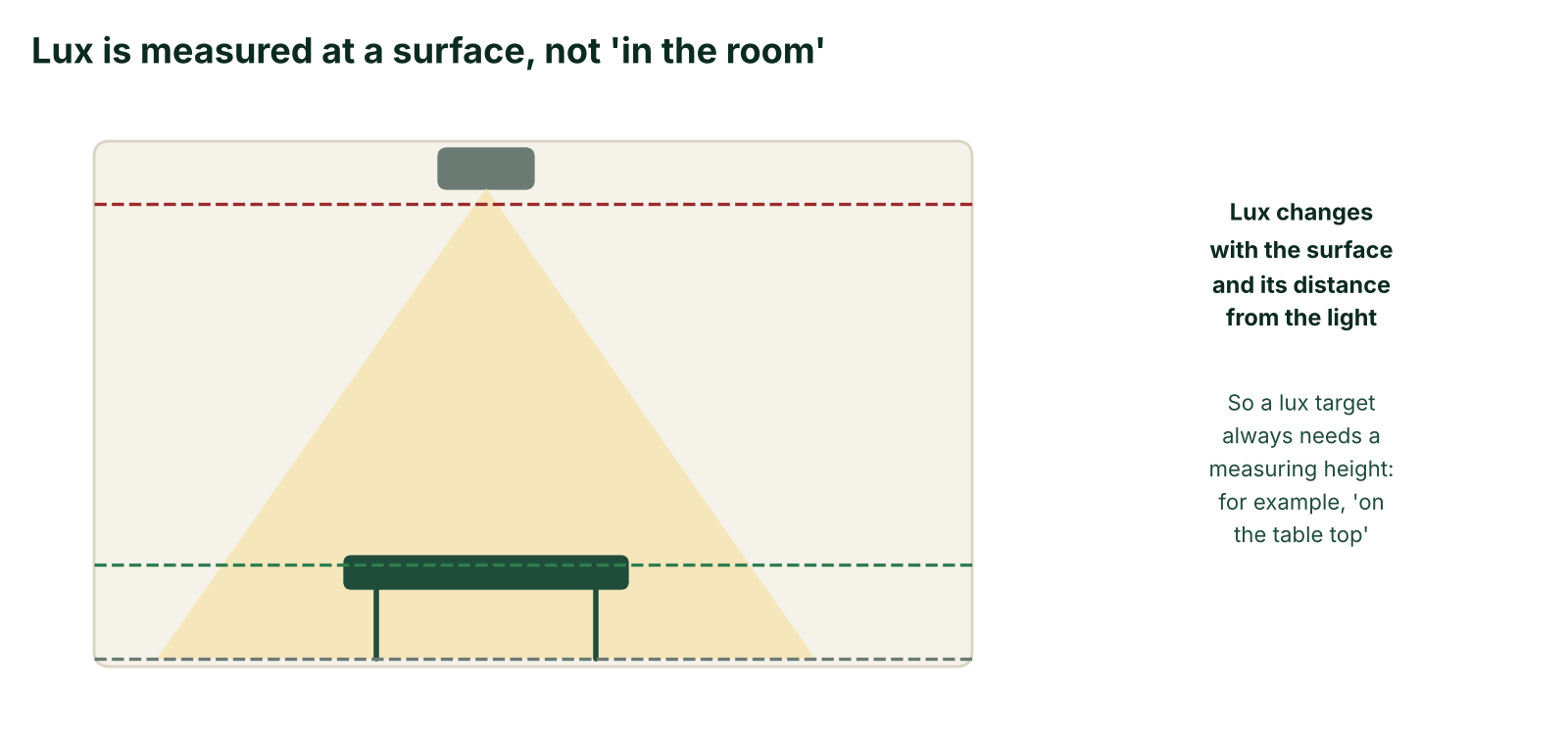
Lux is never "in the room". It is always on a surface, at a certain distance from the light. So when someone says "this kitchen needs 500 lux", the first question should be: 500 lux where? On the counter at work height is very different from lux on the floor.
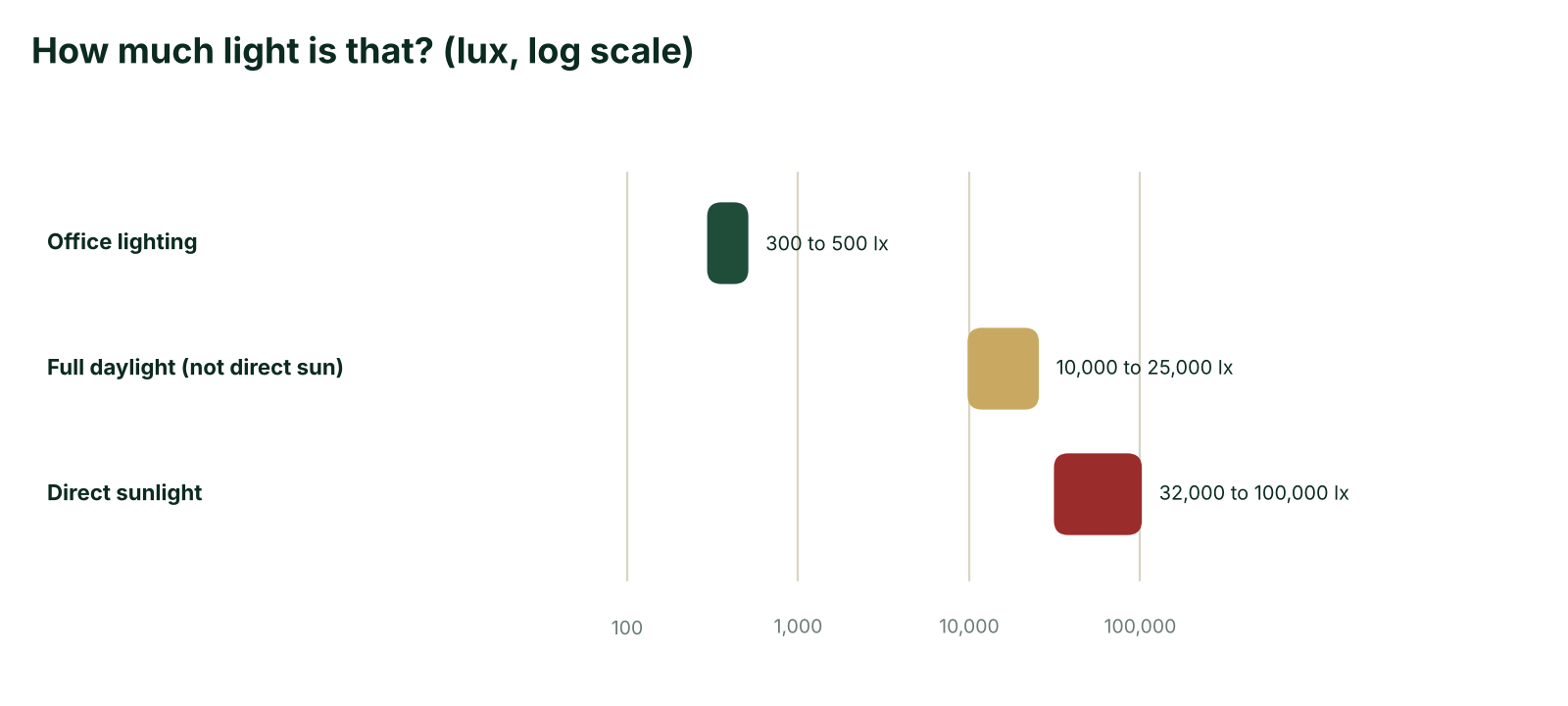
For a feel of the scale, here are some typical values:
Situation | Typical illuminance |
|---|---|
Office lighting | 300 to 500 lux |
Full daylight, not direct sun | 10,000 to 25,000 lux |
Direct sunlight | 32,000 to 100,000 lux |
Sources: Wikipedia, Lux, Ledvance. Even a bright office is a tiny fraction of outdoor daylight, which is why a room can feel dim next to a sunny garden.
Kelvin: the colour of the light, not the brightness
This is the one that gets confused the most. Kelvin has nothing to do with how bright a light is. It describes the colour of white light, from warm and orange to cool and bluish. To see why a temperature scale is used for colour, let me tell you a story about a stone.
Imagine a black stone
Take a black stone and cool it all the way down to absolute zero. That is 0 Kelvin, which is minus 273.15 °C (Wikipedia). The stone is truly black: it takes in the light that hits it and gives nothing back. It also gives off no light of its own. Look at it and you would see what looks like a very deep hole with no end.
Now start heating it. Here is the key idea: every object above absolute zero gives off its own radiation, and the hotter it is, the more of it, and the shorter its wavelength. At first that radiation is infrared, which our eyes cannot see. Even a stone at room temperature glows in infrared (Wikipedia, black-body radiation).
Keep heating and the first visible glow appears at about 800 K (525 °C), a dull red. This is called the Draper point (Wikipedia). By about 1,000 K it is a deep red. Heat it more and the colour moves through orange and yellow to white, and by around 6,500 K you have the bright cool white we call daylight. Go hotter still and it turns blue-white.
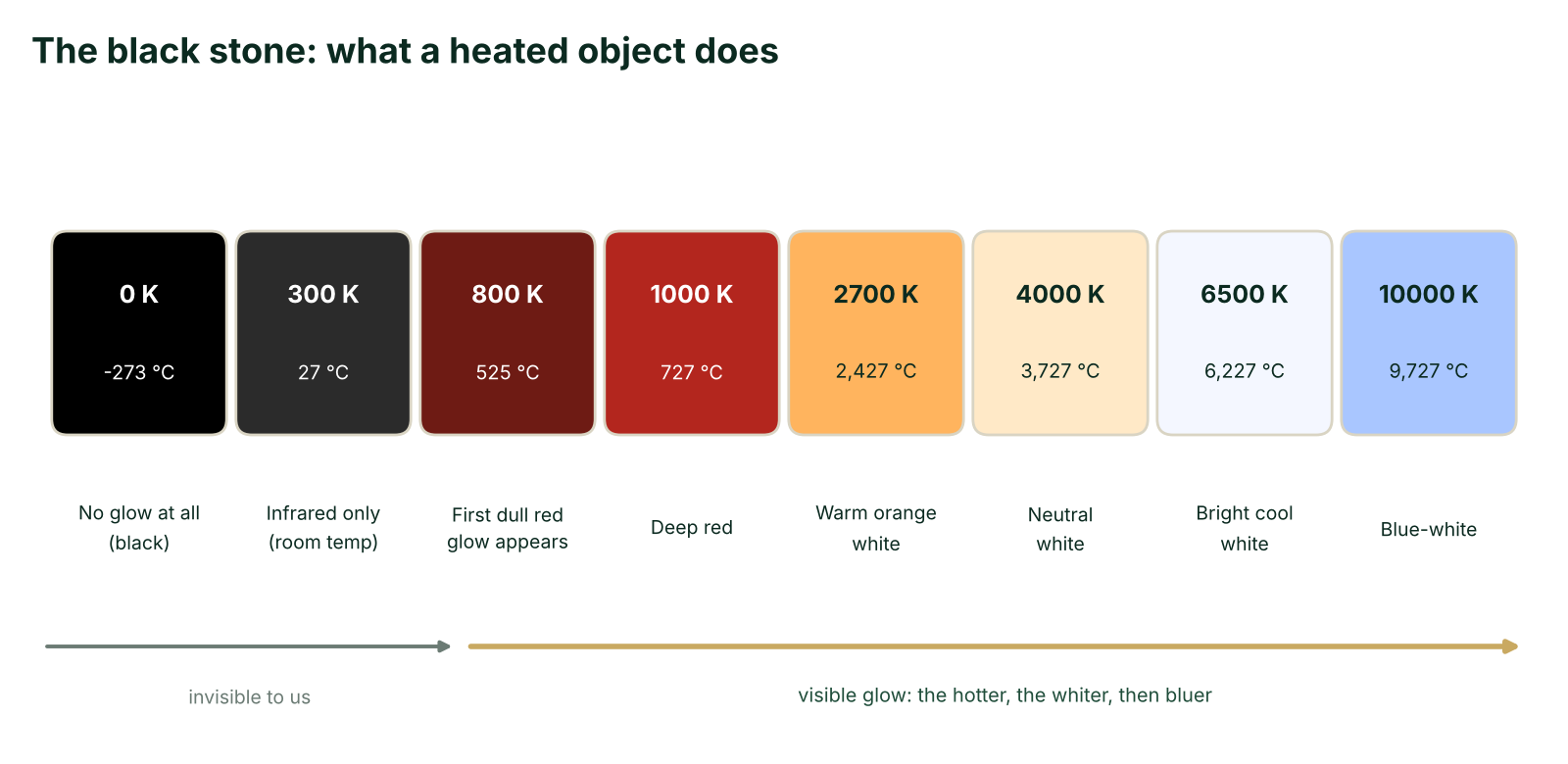
One thing worth knowing. The stone does not turn violet and vanish at 10,000 K. It keeps getting brighter and bluer-white. Past about 10,000 K the peak of its radiation moves into the ultraviolet, which we cannot see, but plenty of visible light remains. Wikipedia says it plainly: a black body "will never become invisible". Hot blue-white stars, like Rigel at about 12,100 K, are proof.
So here is the link: when a lighting engineer says a lamp is 2700 K or 4000 K, he means the lamp looks like a black stone heated to that temperature. The lamp itself is not at that temperature. The proper name is correlated colour temperature, because the number is the temperature of the black stone whose colour looks closest to the lamp (Wikipedia, colour temperature).
A thought I keep coming back to
This idea, fire going from red to white, reminded me of a hadith. The Prophet Muhammad ﷺ is reported to have described the Fire like this:
أُوقِدَ عَلَى النَّارِ أَلْفَ سَنَةٍ حَتَّى احْمَرَّتْ ثُمَّ أُوقِدَ عَلَيْهَا أَلْفَ سَنَةٍ حَتَّى ابْيَضَّتْ ثُمَّ أُوقِدَ عَلَيْهَا أَلْفَ سَنَةٍ حَتَّى اسْوَدَّتْ فَهِيَ سَوْدَاءُ مُظْلِمَةٌ
"The Fire was kindled for one thousand years until it reddened, then it was kindled for one thousand years until it whitened, then it was kindled for one thousand years until it became blackened, so it is dark black."
The order is red, then white, then black. I find it interesting that the steps follow the same order of colours that a heated object really goes through, from red to white then to black where you don’t see the light.
Back to light.
So a 4000 K lamp is not "brighter" than a 2700 K lamp. If both put out 800 lumens, they are equally bright. One just looks cooler.
One more thing: Kelvin is not CRI. CRI measures how faithfully a light shows colours, and the Wikipedia CRI page says it does not indicate the apparent colour of the light. That is given by the colour temperature. So two lamps can look equally warm and still render skin tones and food very differently.
Watts: the bill, not the brightness
For years, watts told us brightness, because every bulb worked the same way. LED changed that. Watts tell you how much electricity the lamp uses. Lumens tell you how much light you get.
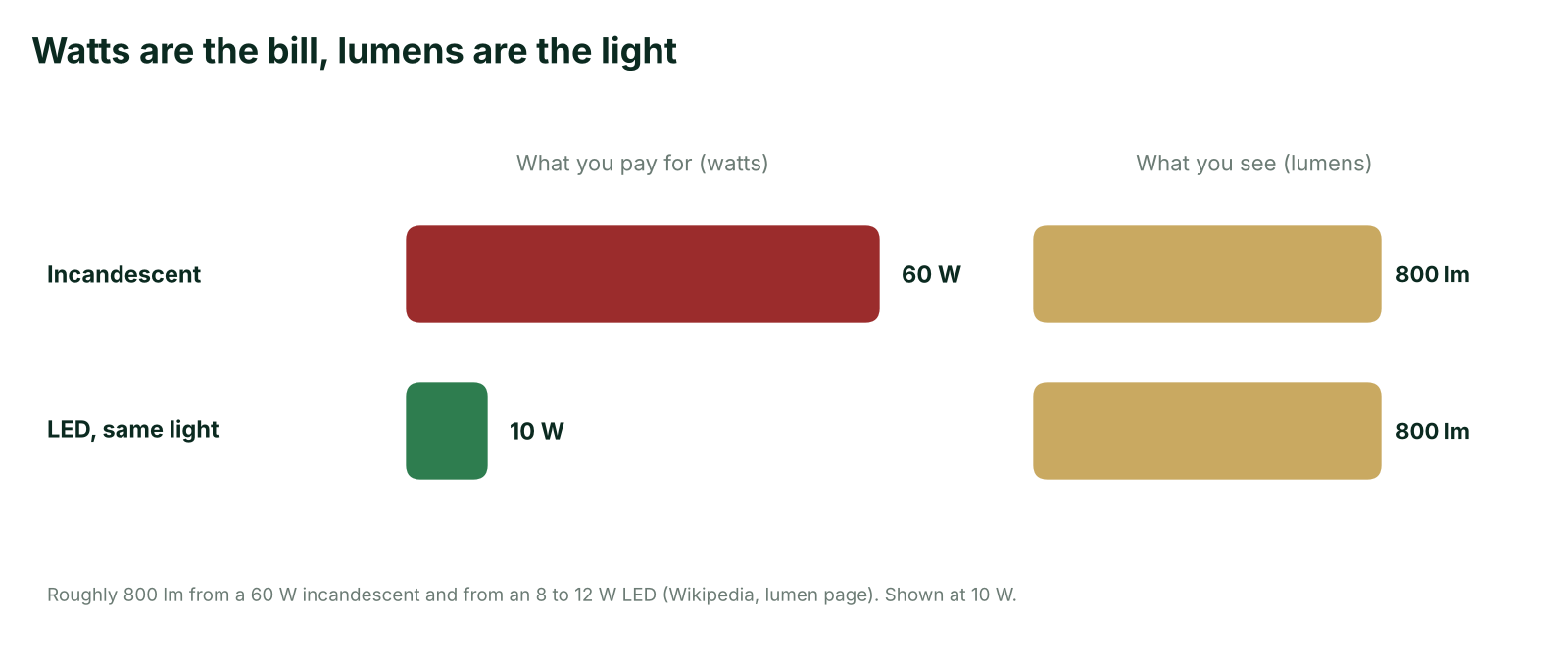
A 60 W incandescent gives roughly 800 lumens, and an LED that gives the same light uses about 8 to 12 W, per Wikipedia's lumen page. The number to compare is lumens per watt, called efficacy. The luminous efficacy page lists incandescent bulbs at around 8 to 18 lm/W and practical LED bulbs at around 75 to 217 lm/W.
The cheat sheet
Lumen | Lux | Kelvin | |
|---|---|---|---|
Question it answers | How much light does the fitting make? | How much light lands on this surface? | What colour is the light? |
Unit | lm | lx (lumens per m²) | K |
Depends on | The light source | Distance, beam angle, area | The light source |
Common mistake | Treating it as room brightness | Quoting it without a measuring surface | Thinking it means brightness |
Before you choose a light, ask three things
How many lumens do I need, and is the fitting really that bright?
Where will the light land, and at what beam angle? That decides your lux on the table, not the box.
What colour feels right in this room? That is Kelvin, and it has nothing to do with brightness.
If you get those three right, you are ahead of most people who buy light by the watt.
Sources
Comments
Be the first to comment.
Questions about this article
What is the difference between lumens, lux and Kelvin?
Lumens measure how much light the fitting produces, lux measures how much lands on a surface, and Kelvin describes the colour of the light. They answer three different questions.
Does a higher Kelvin number mean a brighter light?
No. Kelvin only describes the colour of white light, from warm and orange to cool and bluish. A 4000 K lamp is not brighter than a 2700 K lamp if both give 800 lumens.
Why does the same 1,000 lumen fitting look different with another beam angle?
A narrower beam concentrates the same lumens onto a smaller area, so lux is higher. In the article's example, the tightest beam gave about 16 times more lux than the widest.
What exactly is lux, and how is it calculated?
1 lux is 1 lumen landing on 1 square metre. So 1,000 lumens on 1 m² gives 1,000 lux, while the same light spread over 10 m² gives only 100 lux.
If someone says a kitchen needs 500 lux, what should I ask?
Ask where. Lux is always measured on a surface at a certain distance from the light, so 500 lux on the counter at work height is very different from 500 lux on the floor.
What are typical lux levels for offices and daylight?
Office lighting is typically 300 to 500 lux. Full daylight without direct sun is 10,000 to 25,000 lux, and direct sunlight is 32,000 to 100,000 lux.
Is Kelvin the same as CRI?
No. CRI measures how faithfully a light shows colours and does not indicate the light's apparent colour. Two lamps can look equally warm yet render skin tones and food very differently.
Should I still choose lights by watts?
No. Watts show how much electricity a lamp uses, while lumens show how much light you get. Compare lumens per watt (efficacy): LED bulbs are around 75 to 217 lm/W, incandescent about 8 to 18.
Planning a project?
Talk to our engineers about lighting, control and automation for your space.