

Visible vs Concealed Sockets: Choosing the Right Finish
 Ali Saeed29 Oct 2026 · 8 min read
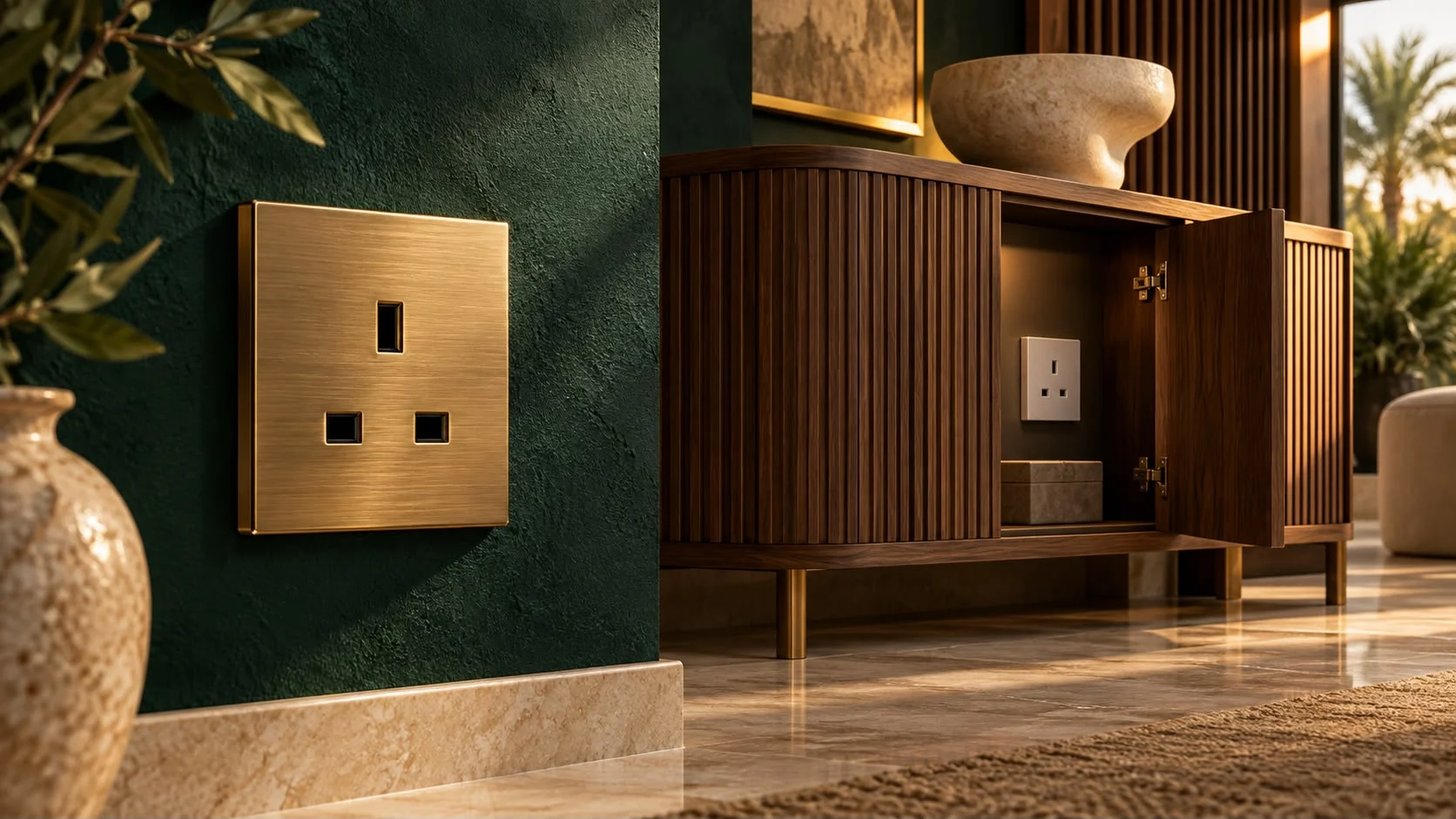
A villa owner may choose a metallic finish for sockets to match the doors, lighting and furniture. But when the furniture layout is reviewed, it becomes clear that some of these points will be visible on the walls, while others will disappear behind TV units or furniture. At that stage, the socket's location becomes part of the purchasing decision, alongside its function and specifications.
The finishing budget can be directed to the points the user will actually see, with a practical, lower-cost alternative chosen for the points that will stay out of sight. This requires reviewing each point individually, while keeping it electrically suitable and easy to use and maintain.
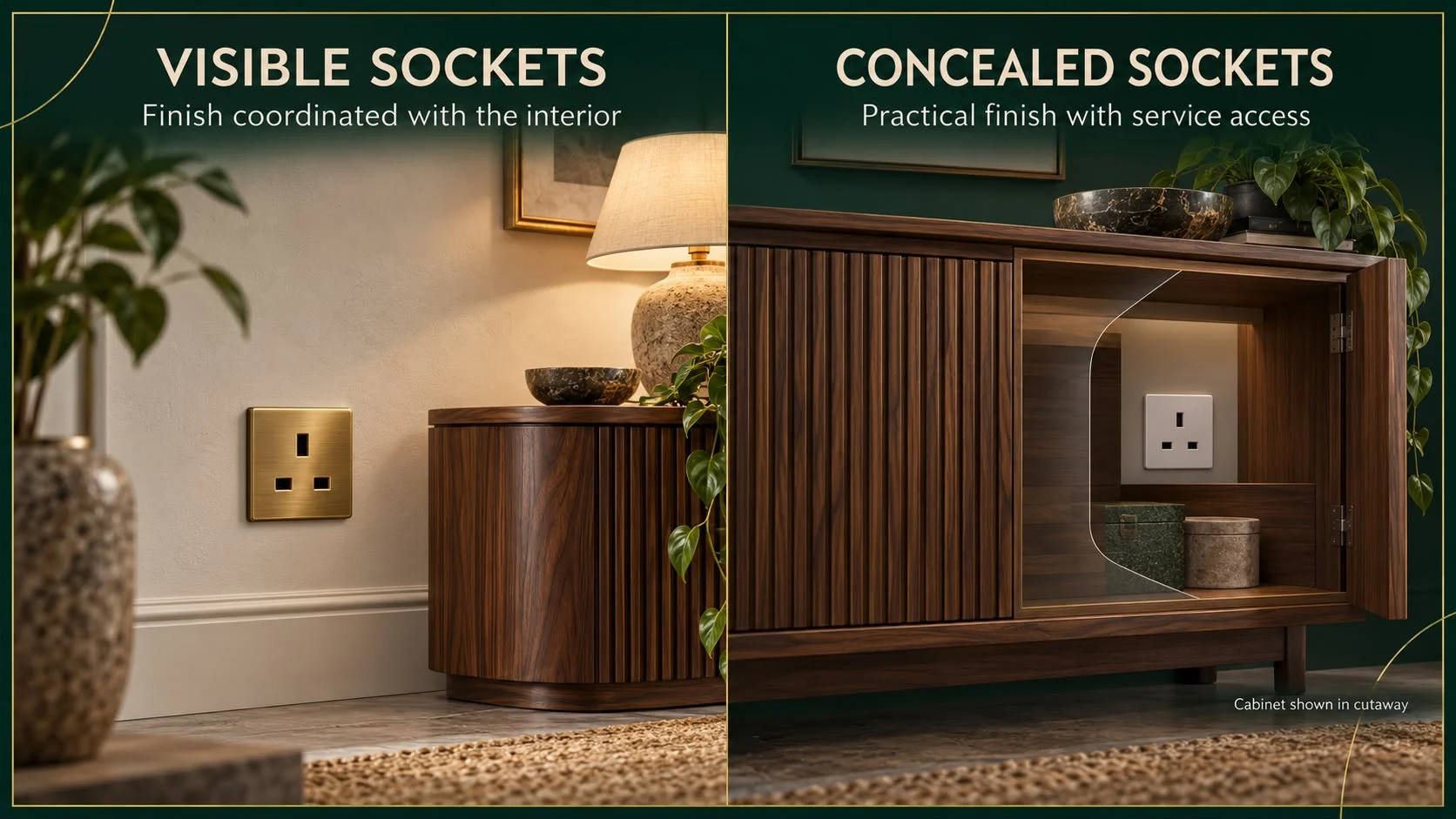
A comparison of finishes for visible sockets and sockets concealed behind furniture, with access maintained for use and maintenance.
What We Mean by Visible and Concealed Sockets
In this article, “visible sockets” are sockets that remain in view after the space is furnished, such as those beside a bed or on a visible wall. “Concealed sockets” are sockets positioned out of sight behind furniture or fittings, with suitable access for use and maintenance.
This classification is based on the final location. Sockets that blend into the wall surface or disappear inside a special mechanism are different design solutions, with their own details and cost. A white socket may be fully visible in one room and hidden behind a fixed unit in another.
There is one category that deserves careful review: points that are visible from a side angle, when seated, or after a chair is moved. Classifying these points requires a realistic picture of the room after handover.
A Practical Example from a JUNG Socket BOQ (Bill Of Quantities)
While preparing a bill of quantities (BOQ) for JUNG sockets in a villa, I needed to decide which finishes to specify at each location. The visible sockets needed to complement the interior design, while the concealed locations allowed for a simpler, practical option.
I selected a coordinated finish for the visible locations and a practical, lower-cost option for the concealed ones. Each choice reflected the socket’s location and use, reducing the client’s cost where a more expensive decorative finish would add no visual value.
Reviewing the items by room, then by SKU, was important for clarifying where each item goes and totaling its quantities. The decision on which finish to choose starts with the location, and its effect later shows up in the quantity take-off and the quotation.
How We Decide Which Points Deserve a Premium Finish
The review starts with the approved furniture layout. I look at the unit's height and width, the socket's position relative to its edge, and the sightlines from the room door and the seating area. A point that looks hidden on a 2D plan may be clearly visible from the side of the furniture.
For visible points, I review the faceplate's color, material, texture and how well it matches the nearby switches. White may be the best fit for a white wall, or a metallic finish for a space built around that material. The aim is a choice that is consistent with the space, and that can be achieved with different finishes.
I also review the function within each assembly. A point beside the bed may need a power socket and a USB charger or a control button, while a point behind the TV serves a different set of connections. For this reason, functions should be defined before the frame style is approved.
Location | Visibility Classification | Selection Priority |
|---|---|---|
Exposed wall beside the bed | Visible | A finish consistent with the design and the required functions |
Point above a worktop | Visible | Appearance, along with the product's suitability for site conditions |
Point behind a fixed furniture unit | Concealed in the approved furniture layout | A practical finish with sufficient clearance and access |
Point behind a movable piece of furniture | Needs review | Consider whether it could become visible if the furniture layout changes |
Finalize the visibility classification after coordinating the furniture layout, sightlines and access to each socket.
Finish Options in the JUNG LS 990 Range
JUNG's LS 990 range shows how finishes can be varied within a single design family. The company offers plastic options, including White, and metal options, including Antique Brass. It describes the Antique Brass finish as treated, hand-finished brass, with frames in different gang configurations. [1] [2]
This variety can be used when coordinating the visible points, and a simpler option can then be considered for the hidden ones. Each assembly must still be approved based on the compatibility of the socket mechanism, faceplate, frame and mounting box, according to the product catalog. For British Standard sockets, JUNG presents configurations that include the mounting mechanism, the design frame and the cover, which is another reason to review the complete assembly. [3]
How to Calculate the Savings
The comparison starts with the price of the assembly that will actually be installed. In systems made up of several parts, the price of the frame alone is not enough. You need to account for the socket mechanism, the cover plate, the frame and any accessory required for installation, or check the price of the complete set if the supplier prices it that way.
Once the function and the required specification are fixed, calculate the cost difference between the two assemblies for each concealed point. Then add up the differences and deduct any extra cost the alternative causes in coordination or installation. If the points differ in function or configuration, calculate each group of similar points separately.
This approach gives the client a comparison that is easy to follow: where the chosen finish was kept, where the alternative was used, and what the actual price difference is. The size of the saving depends on the quantities and prices approved for the project.
Practical Considerations for Concealed Points
When a socket is out of sight, coordination with furniture and joinery matters more. There must be space for the plug and cable, and the access method must allow the required use and maintenance. If a device is connected behind a fixed unit, the appropriate means of isolation should be reviewed as part of the electrical design and the device's instructions. The IET explains that isolation by plug and socket-outlet is achieved by withdrawing the plug, and that the socket switch itself is not necessarily a suitable means of isolation. [4]
The specification of each point remains tied to the load and the conditions of the location. Hiding a socket inside a unit or behind an appliance does not change the heat or moisture it may be exposed to, and does not on its own prove the product is suitable. JUNG offers different options for dry locations and for uses that need splash protection, which confirms the need to refer to the specification of the specific product. [3]
In rooms where the furniture is likely to change, factor into the decision the possibility that the point may become visible in the future. Sometimes a matching socket finish is the better choice, even if a piece of furniture hides it in the first layout.
What to Document in the BOQ
I recommend that each point carry a clear reference linking the room, location and function to its visibility classification and chosen finish. List the component codes of each assembly, the quantities and the unit of measure in a way that distinguishes the number of sockets from the number of frames or accessories.
The By Room version helps when reviewing selections against the plan and the furniture, and the By SKU version helps when consolidating items and reviewing the order. Before purchase, both versions must match the latest design approval. If the position of the TV unit or the size of the bed changes, the affected points should be reviewed again.
Once the technical choice is settled, prices and alternatives are reviewed with the party responsible for pricing and approval. The approved sample remains an important reference for colour and material, because the appearance of a finish on screen may differ from how it looks in the lighting on site.
Choosing the Finish for Each Point
When reviewing a villa's sockets, I start with two linked questions: how will this point be used, and how will it appear once the space is furnished? The answers help you decide the function first, and then direct the finish budget to the locations where the design benefits from it.
Ask for the socket plan to be reviewed against the furniture plan, and for the finishes to be approved location by location before the order is issued. This review makes the budget allocation clear, and reduces the chances of buying high-cost finishes for points that will disappear entirely, or of choosing faceplates that do not match the surrounding finishes at visible locations.
Frequently Asked Questions
Does "concealed socket" refer to a special type of socket?
Here, “concealed” describes the socket’s position out of sight after furnishing. Other products use special mechanisms to hide or integrate sockets into surfaces, so clarify the intended arrangement when specifying or ordering them.
Can two finishes be combined in the same room?
This can be considered when each point is tied to its final location. Review the visual consistency of the exposed points and the compatibility of the components in each assembly, and approve the selections before ordering.
Is white always suitable for concealed points?
White is an option worth considering when it suits the product, the function and the location. The choice is settled by specification, cost and availability, taking into account the possibility that the point may become visible in the future.
How do I know how much I will save?
Compare the total cost of the decorative socket assemblies with the total cost of the practical alternatives at the concealed locations. Deduct any additional coordination or installation costs from the difference to calculate the net saving.
When do I approve the final classification of the points?
After the electrical plan has been coordinated with the furniture, joinery and appliances, and before purchase. Review the classification again when elements that affect the visibility or accessibility of the points are modified.
Sources
Comments
Be the first to comment.
Planning a project?
Talk to our engineers about lighting, control and automation for your space.