

How to calculate Lux for home
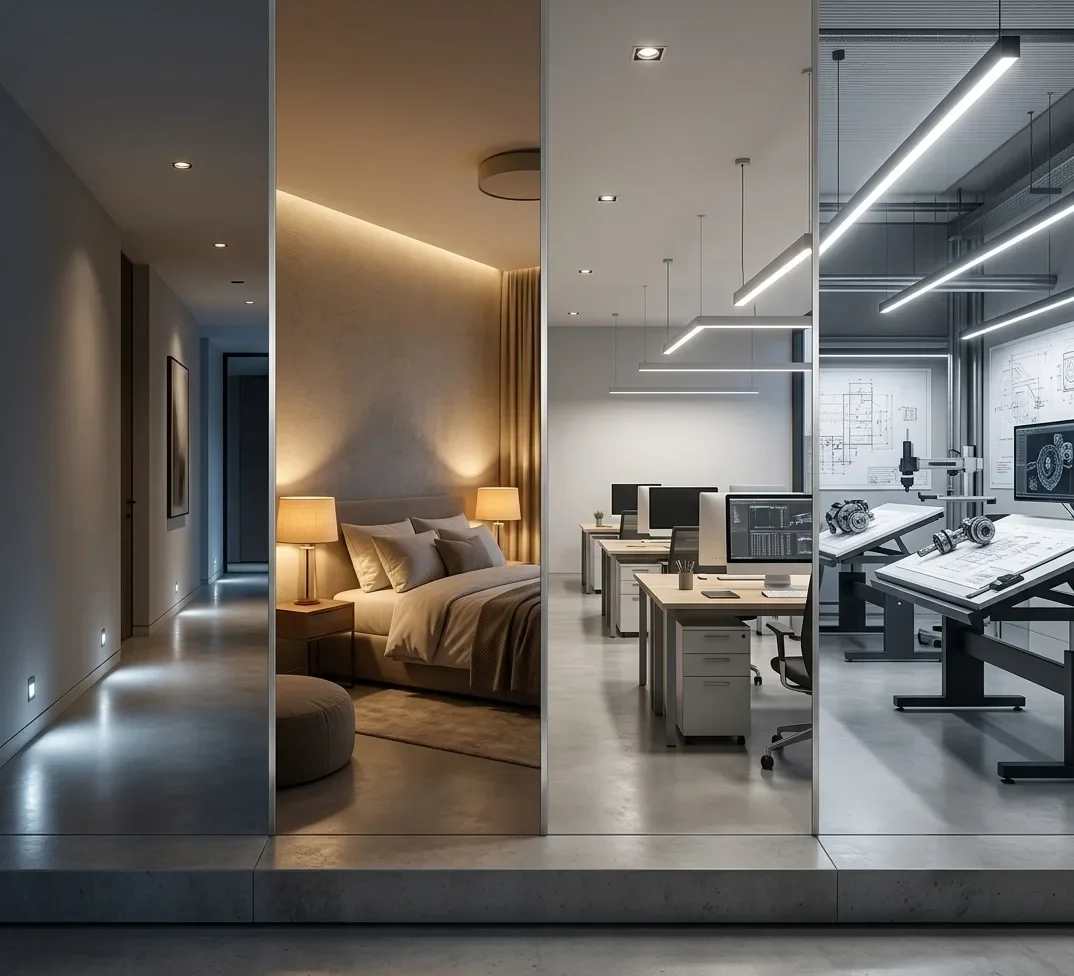
Every space in your home matters, and getting the right amount of light in each one matters just as much. Before you start distributing fixtures around the house, you need to study the space first.
The good news: lux calculation is easy. The bad news: there are a few terms you need to understand, and some room-by-room work to be done. Once you have both, the rest is just math.
Lumen vs. Lux: the two terms you actually need
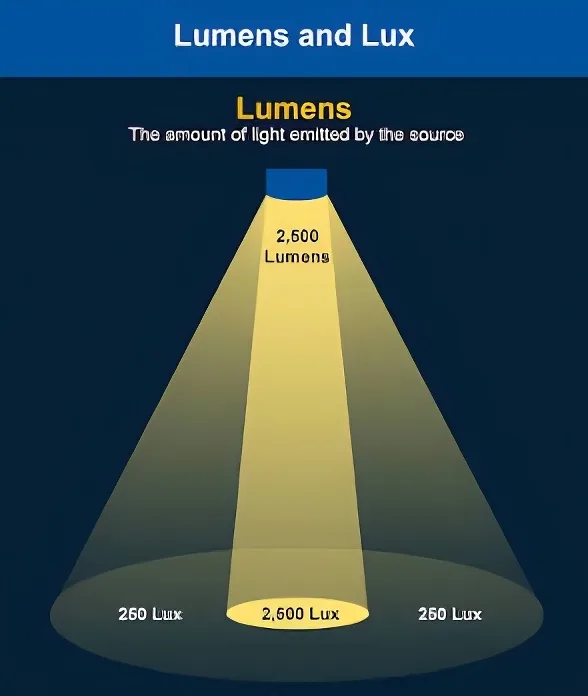
Let's start with lumen. Lumen is the amount of light a fixture can produce.
Here's the part most people get wrong: we don't measure light output in watts. Watt is an old term, and honestly, why we still use it today is a story for another day. What you need to know right now is that watt only measures the electrical consumption of a device, in our case, the fixture. It tells you how much power the fixture is drawing, not how much light it's giving you. Lumen is the number that actually tells you that.
Now, the light coming out of a fixture doesn't stay in one place. It spreads across the room. Some of it lands on your dining table, some on the floor, some on the wall. The amount of that light actually hitting a surface is what we call lux.
So: lumen is how much light a fixture produces. Lux is how much of that light is landing on a given surface.
1 lux = 1 lumen per square meter.
Why this matters: the standards
Once you understand lumen and lux, you can understand why experts set standards for how much lux each type of space needs, and that standard depends entirely on what the room is for.
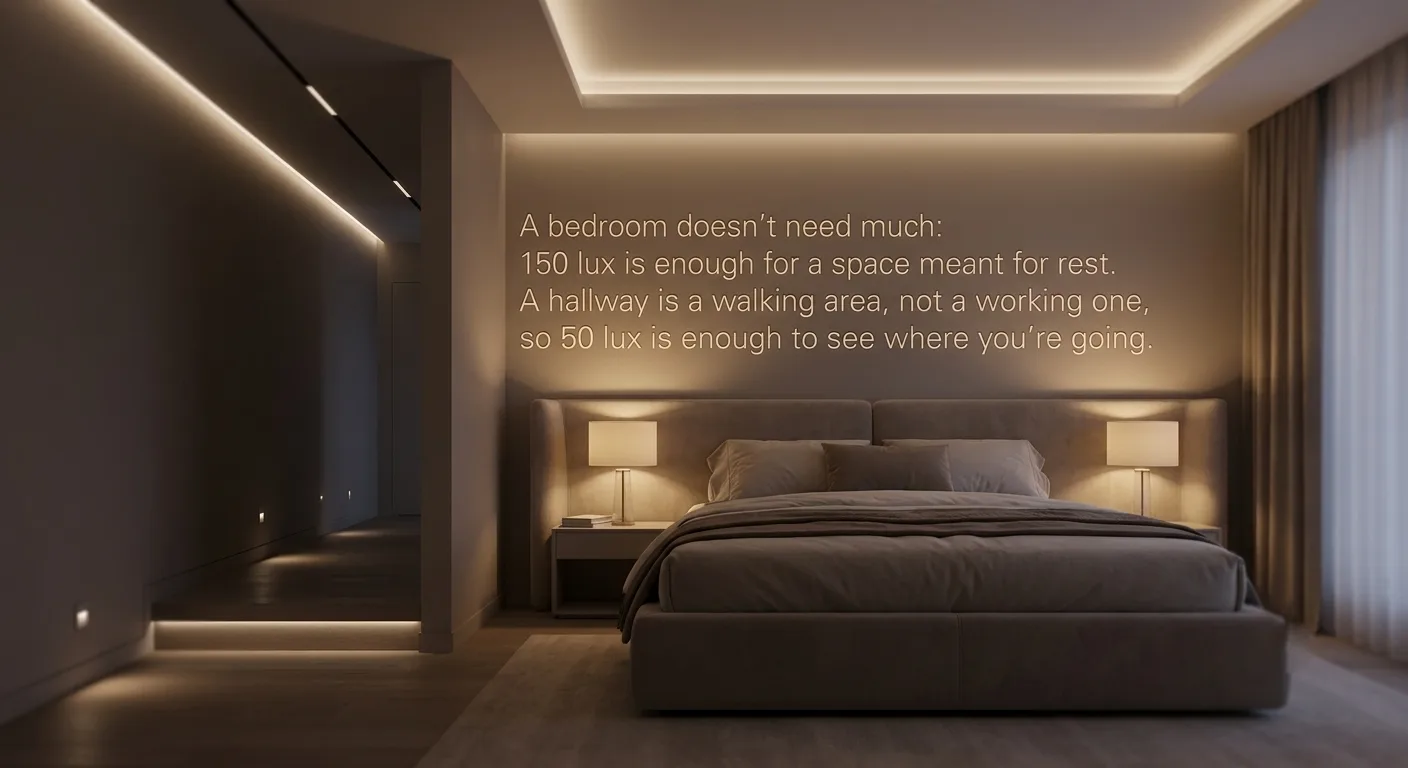
A bedroom doesn't need much: 150 lux is enough for a space meant for rest. A hallway is a walking area, not a working one, so 50 lux is enough to see where you're going. An office, where reading and task work happen, needs 300 lux. A technical drafting or engineering office, where precision matters, can go as high as 2,000 lux.
Here's the part people miss in both directions: going under the standard hurts your eyes when you're trying to focus, and going over it wastes money, on both the electricity and the fixtures themselves.
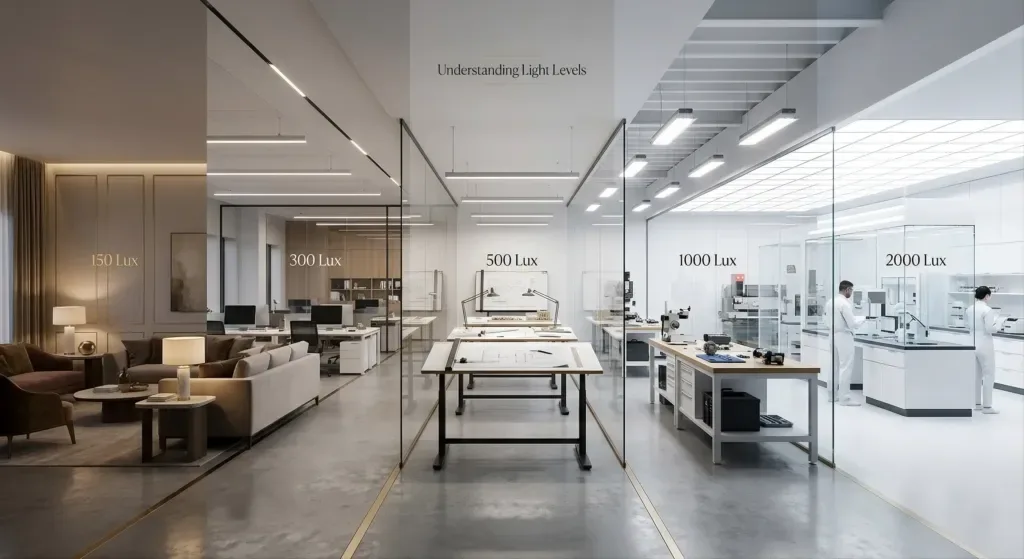
Recommended lux levels by space
Sourcing note: there isn't one single ISO standard that covers every room in a house. Task-oriented spaces (kitchen counters, home offices) are generally referenced against EN 12464-1 / ISO 8995-1 (lighting of work places), while general living spaces (living rooms, bedrooms) follow IES (Illuminating Engineering Society) residential benchmarks. Both are considered industry standard. Confirm this framing is acceptable before publishing.
Space | Recommended lux | Why | Source |
|---|---|---|---|
Bedroom | 150 lux | Rest space, low ambient light | |
Living room | 100–150 lux (dimmable to ~50) | General living, adjustable for mood | |
Hallway / corridor | 50 lux | Walking area only | |
Kitchen (counter/task area) | 300–500 lux | Food prep, task lighting | |
Bathroom (mirror/vanity) | 300+ lux | Grooming tasks | |
Home office | 300 lux | Reading and general task work | |
Technical/drafting office | up to 2,000 lux | High-precision visual work |
How to calculate: the formula
Now that you know the terms, all we need is a simple formula:
Total lumens needed in the room = Standard lux × room area
There's another factor to consider here: the light coming out of a fixture doesn't all land on the surface. Some of it gets lost along the way: factors like ceiling height, wall color, and how the fixture is installed all reduce the lumen amount that actually reaches your surface. Calculating this precisely takes a lot of work, but we can set some general rules to narrow down the margin of error:
Standard ceiling height (around 3m), downlights: you won't lose much, but to stay on the safe side, reduce the lumen output by 20% in your calculation.
Cove lighting: since it's installed in a hidden cove and needs to reflect off the ceiling before it reaches your surface, it typically loses 30–40%. To stay safe, we calculate it as a 50% loss.
Now, back to the standard lux: this part's easy. Just decide what the room's function is. For a living room, we already picked our standard: 150 lux. The space is just as simple: multiply length by width.
Example: A living room, 4m wide by 6m long. What's the lumen requirement?
Lumens = 150 × (4 × 6) = 3,600 lumens
Now, 3,600 lumens is the exact amount we need, but we're going to pump it up by 30%. Why? LEDs lose lumen output over time. The minute you turn the light on, it starts losing lumens. For example, an LED rated L70 at 50,000 hours loses 30% of its light output by the time it hits 50,000 hours of use. Building in that 30% now means the room still has enough light once the fixtures have aged, not just on day one.
So the magic number isn't 3,600. It's 3,600 × 130%. Now we need to decide what light sources are actually emitting light in the space, usually downlights and cove lights, if you have them.
One thing to note: some fixtures don't count in this calculation. Chandeliers, wall lights, and decorative lighting are just decorative. They aren't part of it.
Copy this into Excel
Room | Function | Lux Standard | Length (m) | Width (m) | Area (m²) | Base Lumens | Buffered Lumens (×1.3) | Fixture Lumens | Loss Factor | Fixture Qty |
Living Room | General | 150 | 6 | 4 | 24.0 | 3,600 | 4,680 | 700 | 0.80 | 9 |
|
|
|
|
|
|
|
|
|
|
|
|
|
|
|
|
|
|
|
|
|
|
|
|
|
|
|
|
|
|
|
|
|
|
|
|
|
|
|
|
|
|
|
|
|
|
|
|
|
|
|
|
|
|
|
|
|
|
|
|
|
|
|
|
|
|
|
|
|
|
|
|
|
|
|
|
|
|
|
|
|
|
|
|
|
|
|
|
|
|
|
|
|
|
|
|
|
|
|
|
|
|
|
|
|
|
|
|
|
|
|
|
|
|
|
|
|
|
|
|
|
|
|
|
|
|
|
|
|
|
|
|
|
|
|
|
|
|
|
|
|
|
|
|
|
|
|
|
|
|
|
|
|
|
|
|
|
|
|
|
|
|
|
|
|
|
|
|
|
|
|
|
|
|
|
|
|
|
|
|
|
|
|
|
|
|
|
|
|
|
|
|
|
|
|
|
|
|
Paste this into Excel. The formula cells will calculate automatically. Drag it down and swap in your own lux standard, dimensions, fixture lumens, and loss factor, room by room.
and you can download it here
That's the whole method: know your terms, pick your standard, do the math, then decide your fixtures. Skip a step and you either end up straining your eyes every evening, or paying for fixtures and lumens you'll never use. Do this and you'll notice your fixture count comes down, while you're still sure you're getting the right amount of light for the space.
Downloads
- XLSLighting-Calculation.xlsx7 KB
Comments
Be the first to comment.
Questions about this article
What is the difference between lumen and lux?
Lumen is how much light a fixture produces. Lux is how much of that light lands on a given surface, where 1 lux = 1 lumen per square meter.
Can I use watts to measure how bright a light is?
No. Watts only measure how much electrical power a fixture draws, not how much light it gives. Lumens are the number that tells you the light output.
How many lux does each room in my home need?
A bedroom needs 150 lux, a living room 100–150 (dimmable to about 50), and a hallway 50. A kitchen counter needs 300–500, a bathroom mirror area 300+, and a home office 300.
What happens if I go under or over the recommended lux?
Going under the standard strains your eyes when you try to focus. Going over it wastes money on both electricity and fixtures.
What is the formula for the lumens a room needs?
Total lumens needed = standard lux × room area. The area is simply length times width.
How much light is lost from downlights and cove lights?
With downlights at a standard ceiling height of about 3m, reduce lumen output by 20% in your calculation. Cove lighting typically loses 30–40%, so calculate it as a 50% loss to stay safe.
Why should I add 30% extra lumens to the calculation?
LEDs lose lumen output over time. For example, an LED rated L70 at 50,000 hours loses 30% of its light by then. The 30% buffer keeps the room bright enough after the fixtures age.
Do chandeliers and wall lights count in the lux calculation?
No. Chandeliers, wall lights, and decorative lighting are treated as decorative only and aren't part of the calculation. It usually relies on downlights and cove lights.
Planning a project?
Talk to our engineers about lighting, control and automation for your space.