Design with dali, Day 3
 Moaath Al-Bukaai17 Oct 2026 · 12 min read
Designing with DALI: Sunricher, Lunatone and Interra, Device by Device
Day 3 of the Essentia pre-sales training series. Written for system integrators and engineers who design DALI lighting. A neutral look at three vendors.
Day 3 was the longest day: real model numbers, real use cases, three vendors. We work with Sunricher, Lunatone and Interra, and my goal was not to crown a winner. It was to teach the team to read a datasheet and see in seconds what a device can and cannot do on a DALI line.
Today's roadmap
A recap of the DALI limits every design starts from.
Sunricher: keypads (three control philosophies), masters, gateways, drivers and power.
Lunatone: commissioning tools, touch and Bluetooth control, the sensor interface, relays and gateways.
Interra: DALI switches, the master series and the KNX-DALI gateway.
Three vendors, one line: a worked design example.
A decision framework and scenario practice.
The limits every design starts from
Every device in this article spends from the same budget.
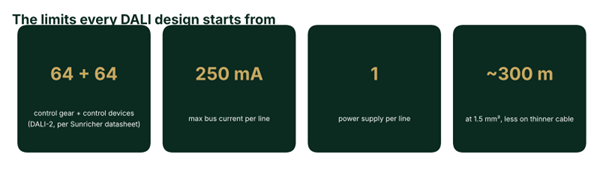
64 control gear and 64 control devices.
250 mA maximum bus current per line.
One power supply per line. Unlike KNX, DALI does not allow two.
About 300 m of cable at 1.5 mm². Less on thinner cable.
Every keypad, sensor and driver spends part of that current and part of those addresses. The vendor and model you choose is a design decision, not a taste decision.
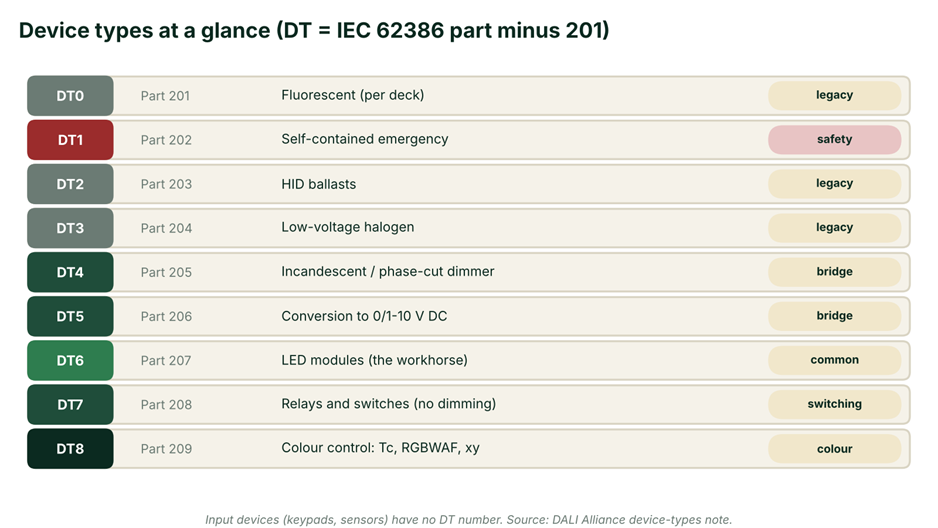
Device types DT0 to DT8
DALI device types apply to control gear only: drivers, dimmers, relays and emergency packs. Input devices such as keypads do not carry a DT number. The DALI Alliance device-types note states the rule directly: the DT number is the IEC 62386 part number minus 201, and "there are no DT numbers for input devices and application controllers."
DT1 to DT4: the original lamp-specific types
DT1 (Part 202), self-contained emergency. This one is safety-critical. It controls emergency battery packs
and runs function and duration tests automatically over the bus, replacing manual logbook testing. My slides tied it to the IEC 62034 automatic-test requirement. I could not verify that link on the pages I read.•
DT2 (Part 203), high-intensity discharge. Metal halide and high-pressure sodium ballasts. Largely legacy.
DT3 (Part 204), low-voltag halogen. Older downlight circuits. Rarely specified in LED-first designs.
DT4 (Part 205), incandescent lamp dimmer. The Alliance's certification timeline calls Part 205 an incandescent lamp dimmer. I described it as the bridge to phase-cut mains-dimmable loads, which is how the products on my slide (Sunricher SR-2303AC-4CH-DIN, Lunatone DALI-2 4Ch PD) use it. It shows up on innovations with existing phase-dimmable transformers, rarely in new LED designs.
DT5 to DT8: the evolution
DT5 (Part 206), conversion to 0/1-10 V DC. Bridges a DALI control layer onto existing analogue-dimmable drivers, so you do not replace them.
DT6 (Part 207), LED modules. One address, one dimmable output on the standard logarithmic curve. This is the
workhorse of most DALI designs. Multi-channel drivers repeat it per channel, each with its own address.
DT7 (Part 208), relays and switches. On and off only, with no dimming curve. For non-dimmable fittings, curtain motors and mains relays.
DT8 (Part 209), colour control. One address coordinates two or more outputs: Tc, RGB, RGBW, RGBWAF or xy. A
single scene command can shift colour temperature and brightness in sync.
A short DALI history
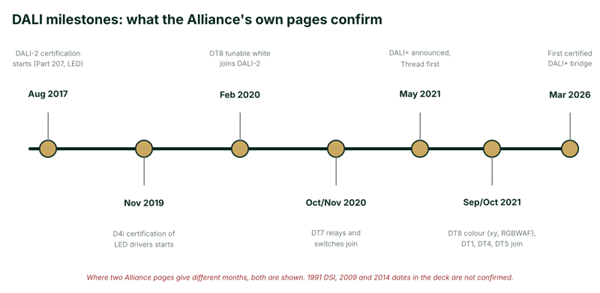
August 2017: DALI-2 certification starts, with Part 207 (LED control gear) in the first phase.
November 2019: DiiA starts D4i certification of LED drivers.
February 2020: tunable white (Tc) is added to DALI-2 certification.
October 2020: Part 208 (relays and switches, DT7) joins. The milestones page says 6 November 2020.
September 2021: Parts 202, 205, 206 and 209 (colour types xy and RGBWAF) join. The milestones page says 4
October, and the colour-control press release is dated 19 October 2021.
May 2021: DALI+ is announced. Per the Thread Group and DALI Alliance release, it brings DALI commands to wireless and IP networks, with Thread as the first network technology, and existing DALI-2 devices connect through a DALI+ bridge.
March 2026: at Light + Building, the Alliance introduced its first certified DALI+ bridge, connecting wireless DALI+ with wired DALI. The same report mentions new certification programs for gateways linking DALI with Bluetooth or Zigbee networks.
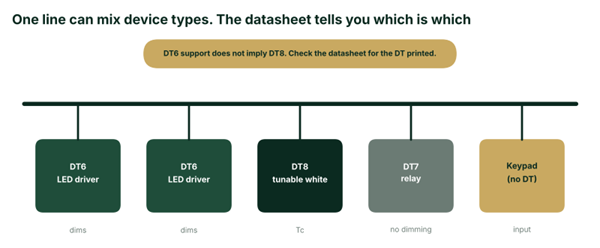
Mixing device types on one line
Before you quote a driver, check three things.
A single line can mix types. DT6, DT7 and DT8 gear can share one line. The master or keypad just needs to
know which address is which type.
DT6 support does not imply DT8. A driver must declare which parts it implements. Look for "DT6" or "DT8" printed on the datasheet. "Dimmable" alone does not confirm colour control.
DT7 never dims. Pair relay gear with curtain motors or non-dimmable fittings, never with tunable-white
downlights.
DT4 is a legacy bridge, not a driver choice. Sunricher and Lunatone driver ranges are mostly DT6 and DT8, Lunatone's relay modules are DT7, and none of the three vendors lead with DT4. Reading a datasheet for a new fixture? Find the DT number before anything else.
Sunricher
Sunricher makes
keypads, masters, gateways, drivers and power supplies
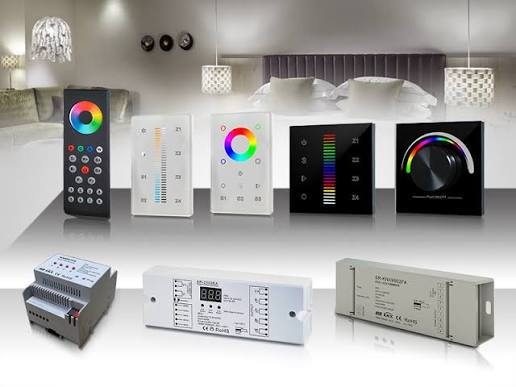
Three keypad philosophies
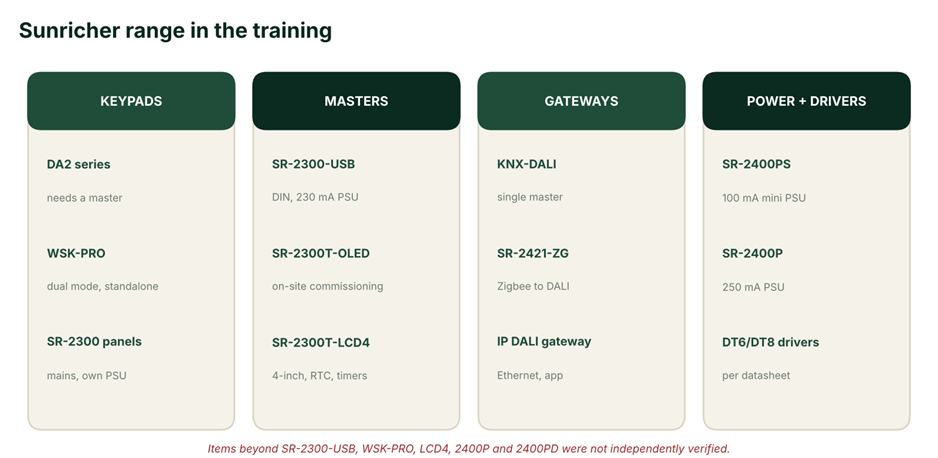
The same 2, 4 or 8 button hardware can be used three different ways. Learning to spot which one you are holding from the datasheet is the main skill of this day.
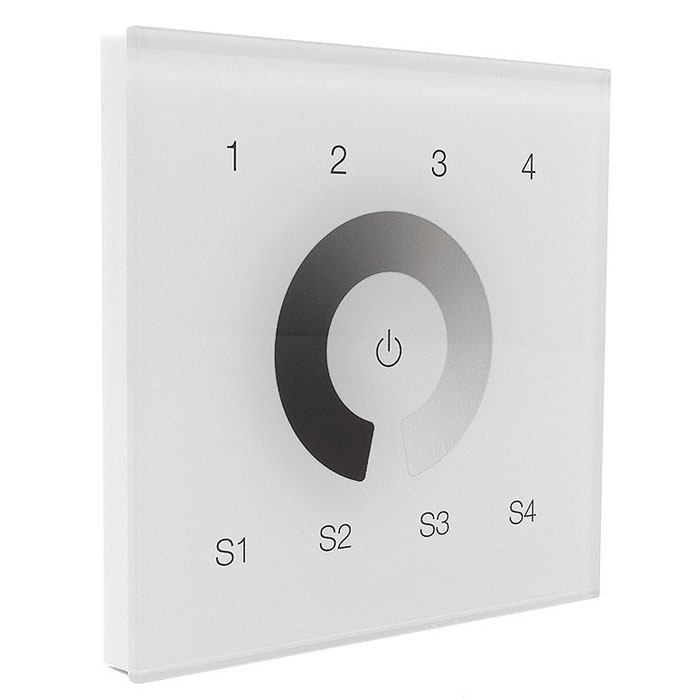
Needs a master (basic DALI-2 input). Models like the SR-2422K4-DA2. It is a certified DALI-2 input device that only sends button events. A separate master or application controller, such as the SR-2300-USB, configures it and decides what the buttons do. Many keypads can share one line, each addressed independently. Best for large networks with many keypads and sensors managed centrally.
Standalone, programmable ("PRO" dual-mode). The model on my slide was written "SR-2422K4-PRO-WSK". Sunricher's catalogue spells it SR-2422K4-WSK-PRO. The page says it operates either as a standard DALI-2 input device or as a standalone controller, chosen by configuration, and draws 2 mA typical and 10 mA maximum from the bus. In standalone mode it drives groups and scenes itself with no master on the line. I described it as "dual-mode". Note that the page describes one mode or the other, not both at once. Best for a small number of keypads where you want real DALI control without buying a master.
Mains-powered standalone. The SR-2300 series wall panels run from 100 to 240 V AC with their own DALI bus supply, with groups and scenes set by rotary switches on the back. No software, no master, no USB. They broadcast to every device on that circuit. Best for a single self-contained room. I took this from
Sunricher's product pages during training. I did not re-verify the model details for this article.
Rule of thumb. Big project with a master planned: basic. Small project, no master
budget: PRO. One self-contained room: mains standalone.
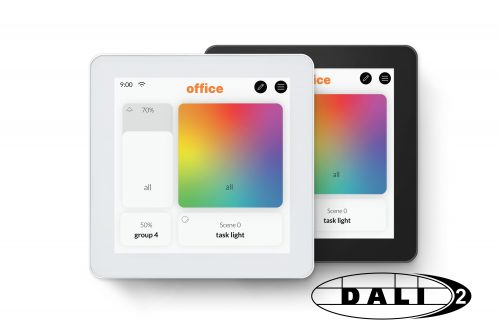
Masters and application controllers.
SR-2300-USB (DIN rail). A central controller for one DALI channel. The retailer page and datasheet give a built-in supply of 230 mA (maximum 250 mA), up to 64 control gear and 64 DALI-2 input devices, USB-B to a Windows PC, a real-time clock and timer tasks. The built-in supply can be disabled with DIP switches when you use an external one. I said it auto-assigns addresses, but I could not confirm that on those pages.
SR-2300T-OLED. A wall or panel master with an OLED screen for on-site commissioning. I could not
independently verify its specification.
SR-2300T-LCD4. A 4-inch touch display master with an RTC, up to 16 timer tasks and PC configuration software, per the Unilight listing. That listing was partly a model-generated summary, so check the datasheet.
Drivers and bus power
The drivers (DT6 for single-channel dimming, DT8 for tunable white and colour) each count against the 64-address and 250 mA budget. For power my slides listed the SR-2400PS, a 100 mA mini supply small enough for a wall box (roughly 50 typical control devices at 2 mA each), and the SR-2400P at 250 mA. The 250 mA figure
matches the DALI maximum, which is a protocol limit, not a marketing number. A Unilight listing shows the 250 mA output, but not the 16 V output voltage from my slide.
Lunatone

Lunatone is an Austrian DALI specialist, known for commissioning tools, sensors and interface modules.
Commissioning tools
DALI-2 USB. The interface between your PC and the DALI bus. The Lunatone folder lists a "DALI USB 30mA" variant with an integrated 30 mA bus supply for small commissioning setups.
DALI Cockpit. Lunatone's configuration and monitoring software. The RM relay datasheet and the KNX gateway datasheet both describe it as free when you use a Lunatone interface. I called it the DALI equivalent of ETS. That
analogy works well with anyone who knows KNX.
DALI Display 7". A7-inch touchscreen. The folder lists two DALI lines (up to 128 operating devices), USB and Ethernet, and 2 mA per DALI line.
Wall and app control
DALI Touchpanel Bluetooth.
Up to 12 buttons, paired with the free DALI Touch app. The folder gives a
Bluetooth range of about 10 to 15 m. Layouts can be rearranged without an
electrician.
KNX-DALI gateway (article 89453899). The datasheet says it is DALI-2 and KNX certified,
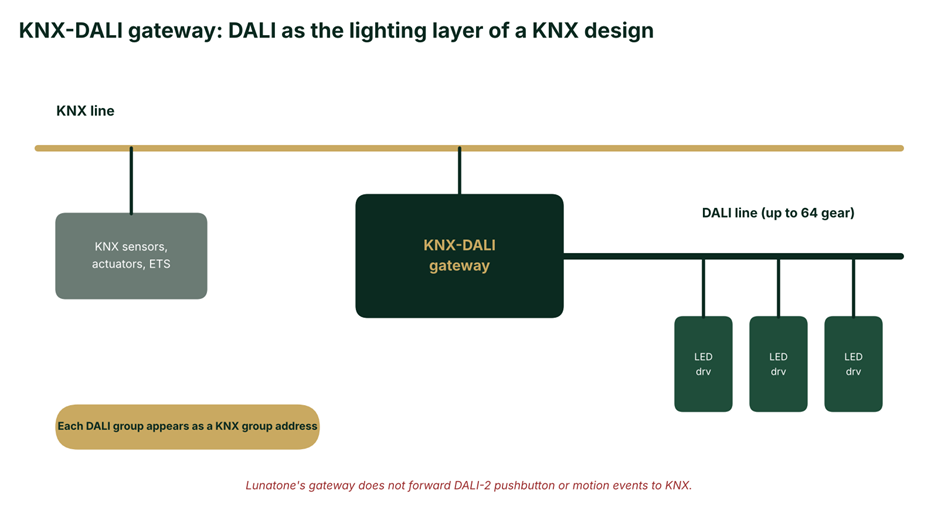
multi-master capable, supports DT0, DT2, DT3, DT4, DT6 and DT8, and has a lamp-failure object (DPT 1.005). It states up to 63 addressable DALI devices, while knx.org lists 64 for the Interra gateway, so check the headcount against the exact model. Two limits matter: it needs an external DALI power supply, and it does not forward DALI-2 pushbutton or motion events to KNX.
Converters and relay modules
RM8, RM16, RM25 relay modules. ratings (8 A, 16 A, 25 A), and the models I checked have a single relay each. They are DT7, powered from the DALI line at 3.8 mA, with programmable power-up behaviour. Some versions limit inrush current. The datasheet is inconsistent on RM16 inrush (320 A in the table, up to 350 A in the overview).
0-10 V / DALI converter. Bridges 0-10 V analogue dimming (Day 1's simplest wired protocol) and DALI, with 1 to 3 channel versions .
DT8 to DT6 and Dim2Warm. Converters for drivers that do not support DT8 natively, and warm-dim curves.
Interra
Interra is a KNX-first manufacturer, and DALI is an integration layer for them, not a separate ecosystem.
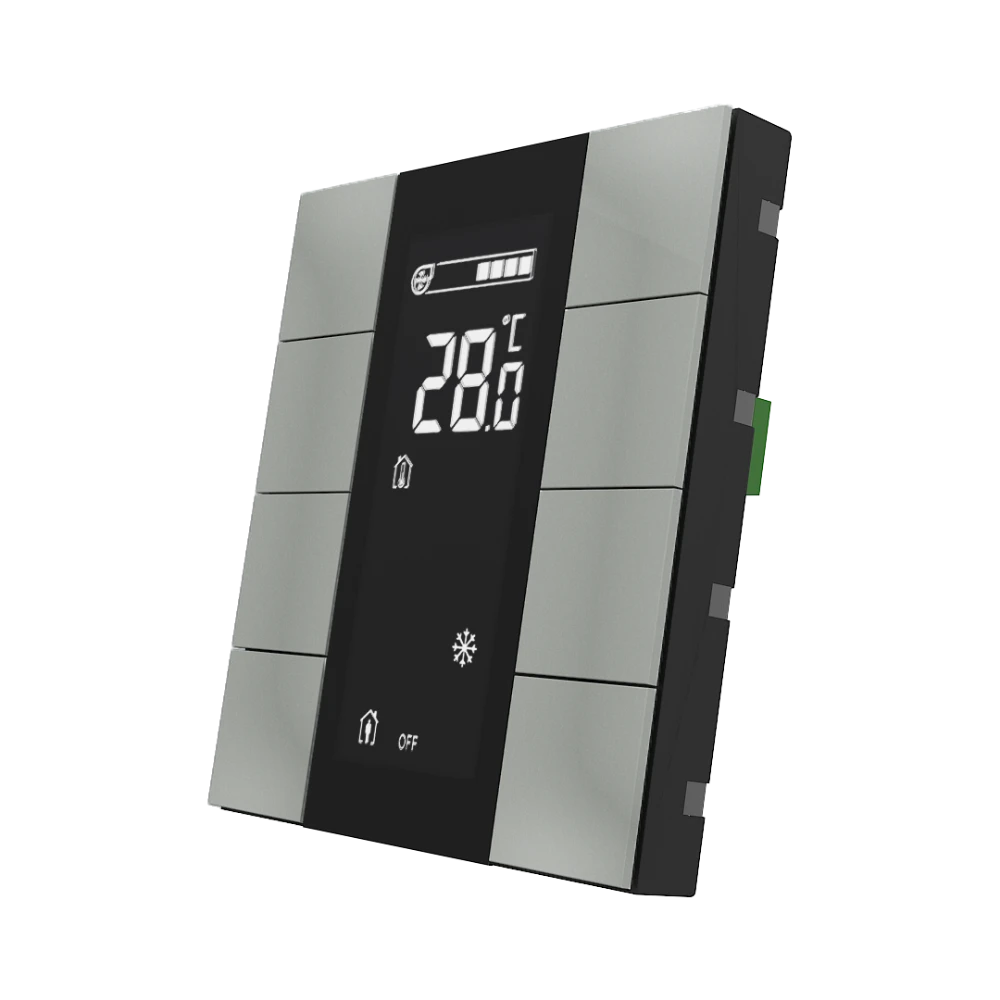
Switches and the master series
Model A (2, 4, 6 or 8 buttons) and Model B (2, 4 or 8 buttons) DALI-2 switches, certified input devices that need a master, the direct equivalent of Sunricher's basic DA2 keypads.
The KNX-DALI gateway
This is Interra's real specialty. The ITR832 gateway comes as a single-channel version (up to 1 × 64 DALI devices) and a dual-channel version (2 × 64), with 16 groups and 16 scenes per channel and an internal DALI power supply. The knx.org listing confirms the 1 × 64 and 2 × 64 variants.
Two items to watch. First, I said it supports emergency-lighting tests per EN 62386-202 as abuilt-in feature. DirectIndustry says it is supported,
Three vendors, side by side
Same DALI standard underneath, different strengths on top. Read the table as a guide to where each vendor leads, not a league table.
Sunricher is the broadest on standalone options (the PRO keypads and the mains panels) and on masters.
Best fit: standalone DALI projects, mid-size or large.
Lunatone is the specialist for retrofits and mixed-brand projects: the sensor interface, the Cockpit
tooling, the relays and the touch and Bluetooth options. Best fit: retrofit-heavy jobs.
Interra leads with the KNX-DALI gateway. Best fit: KNX-led projects where DALI is one layer hanging
off a gateway, not a large standalone DALI installation.
Choosing a vendor and device: five questions
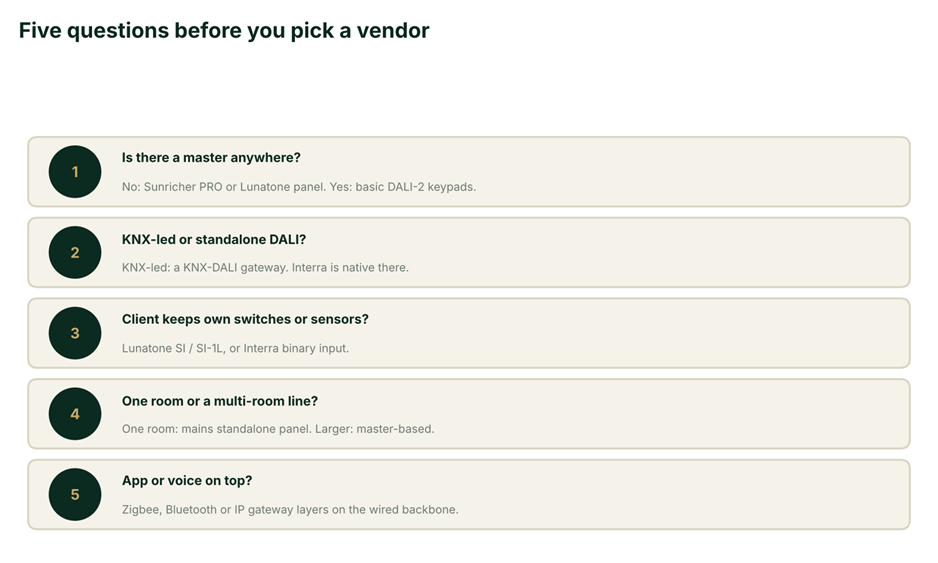
Is there a DALI master or
application controller anywhere in this design? If not, you need PRO
keypads or a mains-powered panel. If yes, basic DALI-2 keypads become an
option.Is the project KNX-led or standalone DALI? KNX-led points to a KNX-DALI gateway, and Interra is
native there.Does the client already own switches or sensors they want to keep? Think Lunatone SI or SI-1L.
One self-contained room, or a larger multi-room line? One room suits a mains-powered panel. A larger line wants a master.
Does the client want app or voice control on top of the wired backbone? Look at the Zigbee, Bluetooth
and IP gateways.
Scenario practice
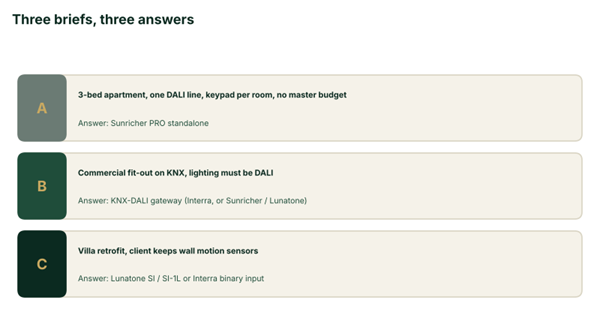
A. A 3-bedroom apartment with one DALI line, one keypad per room, and no budget fo a master. Sunricher PRO standalone keypads. Direct scene and group mode, no master, low cost on a small line.
B. A commercial fit-out standardised on KNX for everything except lighting, which must be DALI. A KNX-DALI gateway: Interra's, or the Sunricher or Lunatone equivalent. DALI is the lighting layer under a KNX-led design. If the line will carry DALI-2 push-buttons or sensors, note that Lunatone's gateway does not forward their events to KNX.
C. A villa retrofit where the client insists on keeping existing wall-mounted motion sensors. Lunatone DALI-2 SI or SI-1L, or Interra's binary input if it exists in the form I described. Either bridges the client's conventional sensors onto the DALI line.
Key takeaways
Every DALI input device follows one of three philosophies: needs a master, standalone-programmable, or
standalone with its own power. Learn to spot which from the datasheet.
Sunricher's PRO keypads and Lunatone's panels with a built-in supply solve the same problem differently:
both let you skip the master.
Lunatone's SI and SI-1L are the tool for keeping a client's existing switches and sensors.
Interra's strength is the KNX-DALI gateway, best when DALI is one layer in a KNX-led design.
Everything must fit the limits: 64 control gear and 64 control devices, 250 mA, one power supply per line.
Check the datasheet for the DT number first. DT6 does not imply DT8, and DT7 never dims.
Sources
Downloads
- PPTDay3_DALI_Devices.pptx3.3 MB
Comments
Be the first to comment.
Questions about this article
What limits apply to every DALI line?
A line supports 64 control gear and 64 control devices, with a maximum bus current of 250 mA. It allows only one power supply and about 300 m of 1.5 mm² cable, or less on thinner cable.
Do keypads and other input devices have DT numbers?
No. DT numbers apply only to control gear such as drivers, dimmers, relays and emergency packs. The DT number is the IEC 62386 part number minus 201.
What is the difference between DT6 and DT8 drivers?
DT6 gives one address and one dimmable output, and it is the workhorse of most designs. DT8 coordinates two or more outputs for colour control, and DT6 support does not imply DT8.
What does a DT7 device do, and where should I use it?
DT7 covers relays and switches. It only switches on and off, with no dimming curve. Use it with non-dimmable fittings, curtain motors and mains relays, never with tunable-white downlights.
Can different device types share one DALI line?
Yes. DT6, DT7 and DT8 gear can share one line. The master or keypad just needs to know which address is which type.
What are the three keypad philosophies in the Sunricher range?
The first needs a master (basic DALI-2 input). The second is standalone and programmable (PRO). The third is mains-powered standalone, like the SR-2300 series wall panels.
When should I choose standalone PRO keypads?
Choose them for a small project with a few keypads and no budget for a master. In standalone mode they drive groups and scenes themselves with no master on the line.
What does DT1 do?
DT1 is self-contained emergency lighting and is safety-critical. It controls emergency battery packs and runs function and duration tests automatically over the bus, replacing manual logbook testing.
What is DALI Cockpit?
It is Lunatone's configuration and monitoring software. It is described as free when you use a Lunatone interface, and it works as a DALI equivalent of ETS.
What are the limits of Lunatone's KNX-DALI gateway?
It needs an external DALI power supply, and it does not forward DALI-2 pushbutton or motion events to KNX. Also check the device count: its datasheet states 63 addressable devices.
How can we keep a client's existing switches or motion sensors on DALI?
Use the Lunatone DALI-2 SI or SI-1L interface. It bridges the client's conventional sensors and switches onto the DALI line.
When is Interra the right choice for DALI?
Interra is the best fit for KNX-led projects where DALI is one layer hanging off a gateway. Its ITR832 gateway comes as a single-channel (1 × 64) or dual-channel (2 × 64) version. It is not aimed at large standalone DALI installations.
Planning a project?
Talk to our engineers about lighting, control and automation for your space.