Vimar Training, Day 2
 Moaath Al-Bukaai17 Oct 2026 · 11 min read
Box, Frame, Device, Plate: Vimar Wiring
Devices for Pre-Sales Engineers
Day2 of the Essentia pre-sales training series. Written for system integrators and
engineers who specify wiring devices in the Gulf.
Day 2 of the training was about Vimar. Essentia is a Vimar authorized partner in Bahrain and
Saudi Arabia, so our team prices Vimar wiring devices almost every week. And
here is the thing I keep seeing in our quotes: most mistakes have nothing to do
with automation. They come from boxes, frames and plates.
So I spent a full day on those three things. This article walks through that day, slide by
slide, with the extra context and sources I added afterwards. It is the second
post in the series. Day 1 covered the protocols and Day 3 covers DALI devices.
Today's roadmap
The day followed six steps, and so does this article:
Who Vimar is and where they fit in our business.
The anatomy of a wiring point: box, frame, device, plate.
International standards (Italian, German/French, British) and which one Bahrain needs.
The five families: Plana, Arké, Idea, Eikon and Linea.
Why an Eikon frame only takes Eikon devices and Eikon plates.
Monoblock devices, where the whole point comes as one piece.
Who Vimar is
Vimar was founded on 1 May 1945 behind the medieval walls of Marostica, in north-east Italy. Vimar's own timeline credits an idea shared by Walter Viaro and Francesco Gusi. The early catalogue was humble: lampholders, plugs, socket outlets and simple switches, according to Vimar's historic-brand page. In 2025 the
company marked its 80th anniversary, and it is still designed and made in Marostica.
That same page tells us Vimar sits on the Italian Ministry of Economic Development's register of Historic Brands of National Interest. The criterion is a registered trademark, or continuous use, for at least 50 years.
The numbers
Vimar's own page (written in 2022) gives these figures: over 12,000 catalogue items, distribution in more than 100 countries, 200 million parts produced a year, 1,300 employees (1,000 of them in Italy) and four production plants, all in Marostica. They are three years old, so treat them as a snapshot.
Modularity: how a wiring point goes together
The four parts
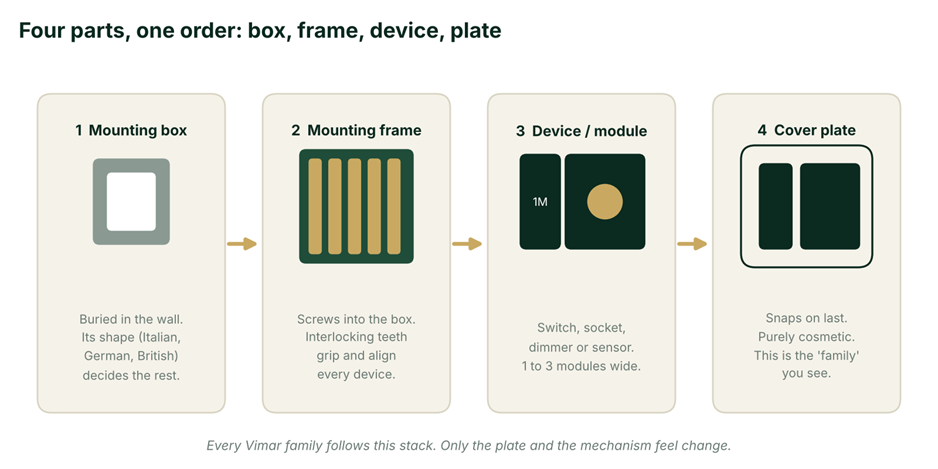
Every Vimar point is built the same way, in this order:
Mounting box. Set into the wall. Its shape (Italian, German or British) decides everything that stacks on
top.Mounting frame. Screws into the box. Interlocking teeth grip and align each device. It runs from one module up to large multi-gang compositions.
Device or module. The actual switch, socket, dimmer or sensor. Each is 1 to 3 modules wide, and several can share a frame.
Cover plate. Purely aesthetic, and it snaps on last. This is what defines the family look.
The frame does the quiet work
The frame is the one part that decides how flexible and how serviceable an installation is.
Module maths is simple: devices are 1, 2 or 3 modules wide, and the widths have to add up to the plate. A 1M switch, a 2M socket and a 1M blank all fit under one 4-module plate.
Vimar's own catalogue says its controls come in one, two and three modules (British Standard catalogue). The largest compositions in my slides were up to 18 modules on Idea and up to 21 on Eikon (7+7+7). Those two numbers come from our training material.
Front fixing versus rear fixing
This is the detail that hurts on site.
Front fixing (Plana, Arké, Eikon): devices click into the frame from the front. You can service or swap a device later without removing the frame from the box. The mechanism behind it is Vimar's "Plack-clack" system.
Rear fixing (Idea): devices go in from behind the frame before final wiring. It is mechanically well regarded, but swapping a device later usually means pulling the frame. Plan the sequence with the electrician.
One more thing from the slide notes. DIN-rail frames (distribution boards) and surface-mount IP55 boxes can carry Eikon, Arké and Plana devices together, because no shared decorative plate is at stake there.
International standards: same devices, three shapes
Vimar cuts the same family three ways, depending on which wall box it has to fit:
Italian / international. 22.5 × 45 mm per module, so three modules is about 67.5 mm wide. Vimar's home standard, shared with Bticino.
German / French. Centres of 71 mm (German) or 57 mm (French). Matches Gira, Berker, Busch-Jaeger and
Legrand-style boxes.
British Standard (BS). Plates sized in modules (2M to 5M and beyond) to match the British box.
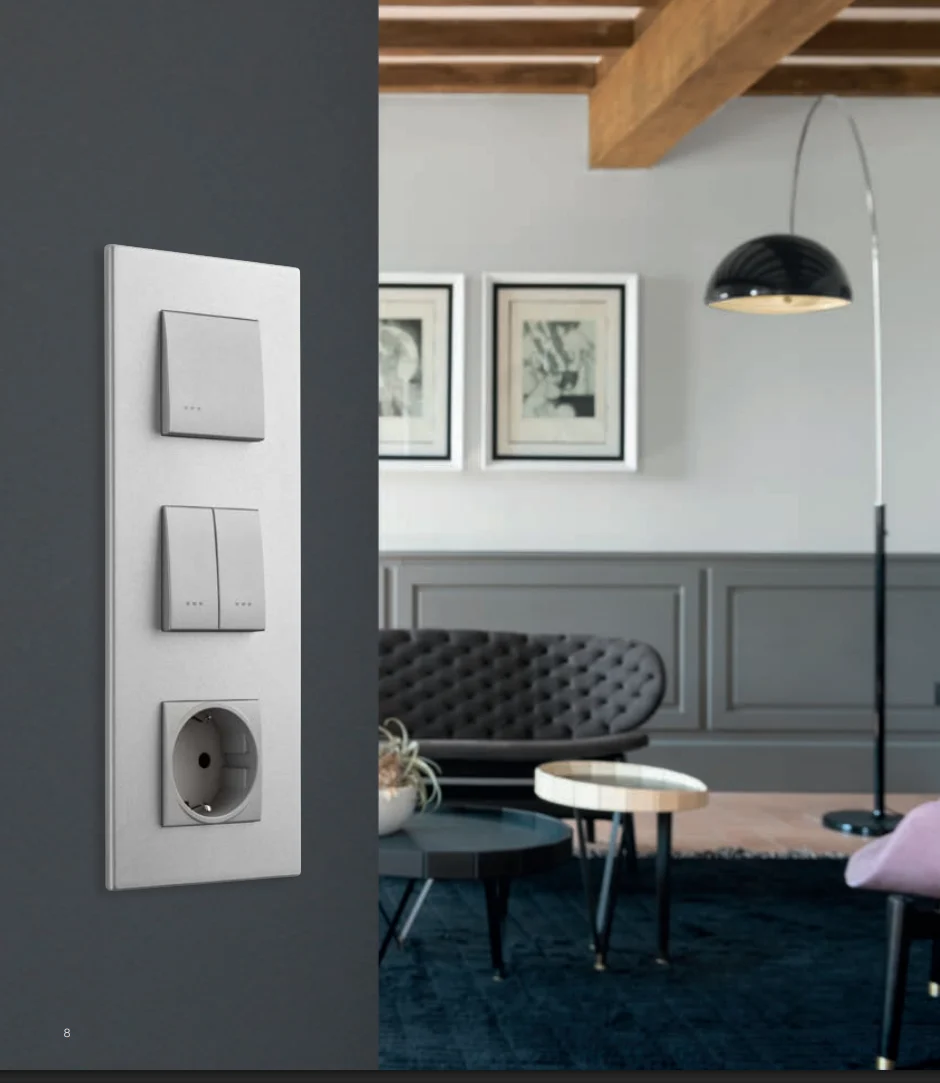
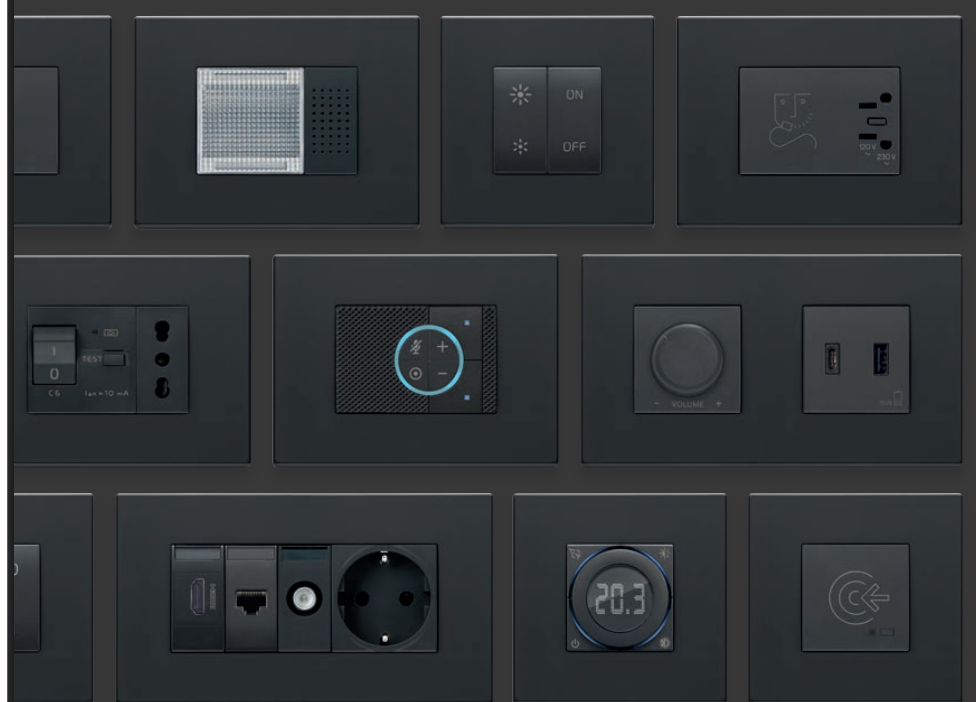
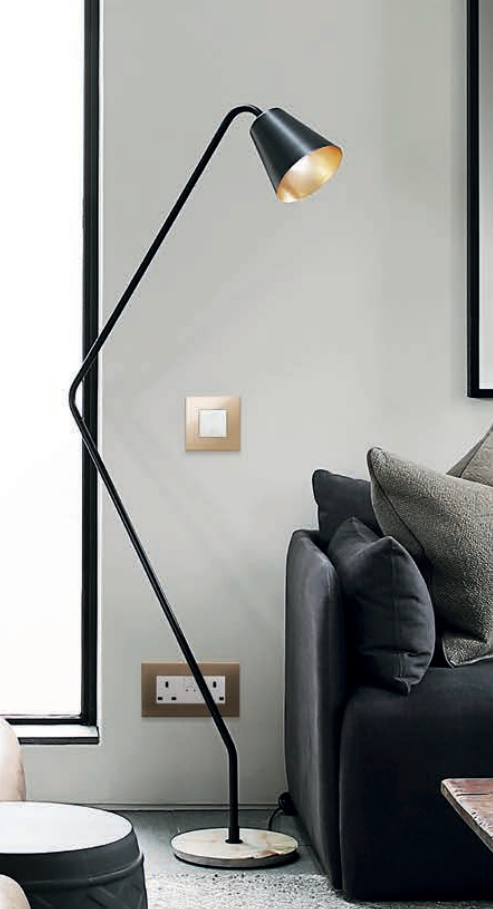
For the British box, Vimar's catalogue gives fixing centres of 60.3 mm for a 1-gang box and 120.6 mm for a 2-gang box. In my slides I also quoted box sizes of 86 × 86 mm and 86 × 146 mm "per BS 5733". I could not confirm those two sizes in any page I read. And in Vimar's catalogue BS 5733 shows up as a device standard
on a cable outlet, not as a box-dimension standard. The same catalogue states conformity to BS EN 60669-1. When you write a spec, cite the standard for what it actually covers.
Why BS in the Gulf
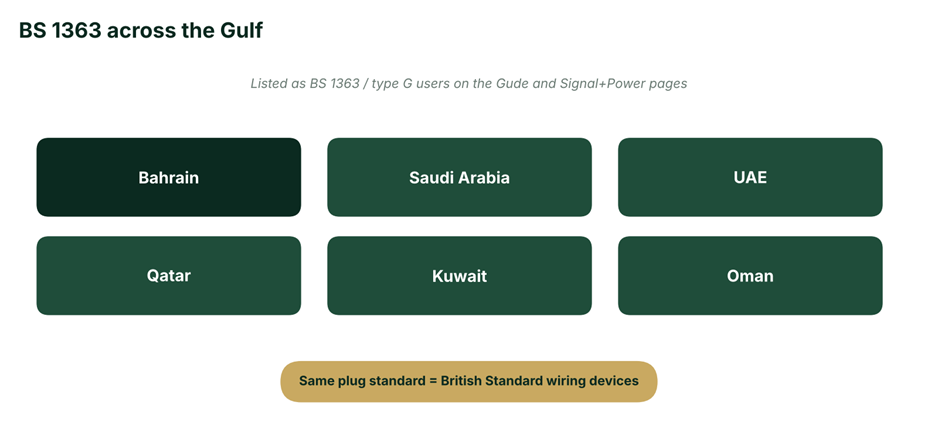
Bahrain, Saudi Arabia, the UAE, Qatar, Kuwait and Oman all use the British BS 1363 plug. Gude Systems lists all six as type G countries, and Signal+Power describes BS 1363 cords for the Gulf states. So almost every Essentia quote needs the British Standard version of whichever family the client picks, whatever Vimar's Italian home catalogue shows first.
The rule I repeated all three days
This was the question I got most on Day 2, so here it is as a rule.
Whatever standard you start with, the whole house follows. If one room is Italian, every room is Italian. If it is BS, it is BS everywhere. You cannot mix them, because the boxes in the wall have different shapes and the plates will never sit square.
And in Bahrain the default is BS, always. The only time I accept the Italian standard is when a big function demands it. Italian frames go much wider than BS, up to 21 modules on an Eikon composition, and that gives you a wall of push buttons no BS plate can hold. If the client needs that, go Italian for the entire house and tell them why. Otherwise, BS.
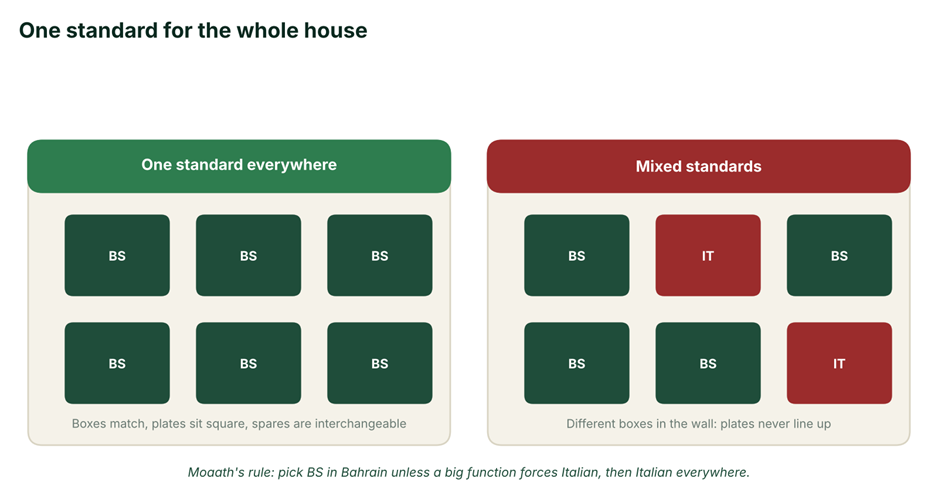
The two most common errors in our quotes come straight from this. First, Italian gets priced because it is the catalogue default, and the boxes on site are BS. Second, a client picks Eikon plates and later wants a cheaper device under them. More on that second one below.
The five families
These are five tiers, not five colours of the same thing. The tier order and Bticino equivalents below come from my training slides.
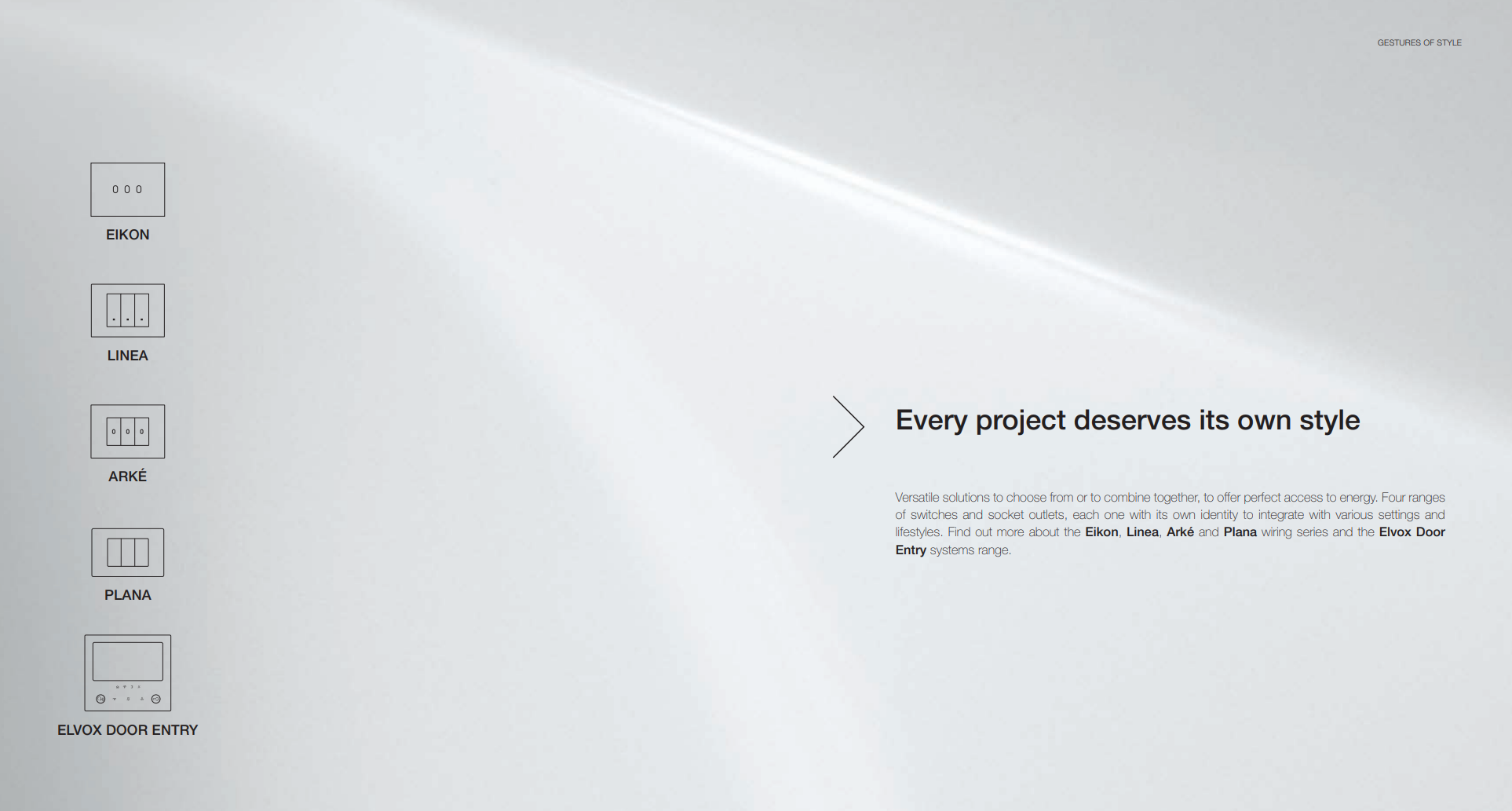
Plana: entry, and hard to beat on value
Plana isVimar's most balanced price-to-quality series, with a slim, frameless technopolymer look. In training I described the structure underneath as shared with Arké and Eikon, so the step up between tiers is mostly materials, finish and mechanism feel. It sits roughly where Bticino Light sits.
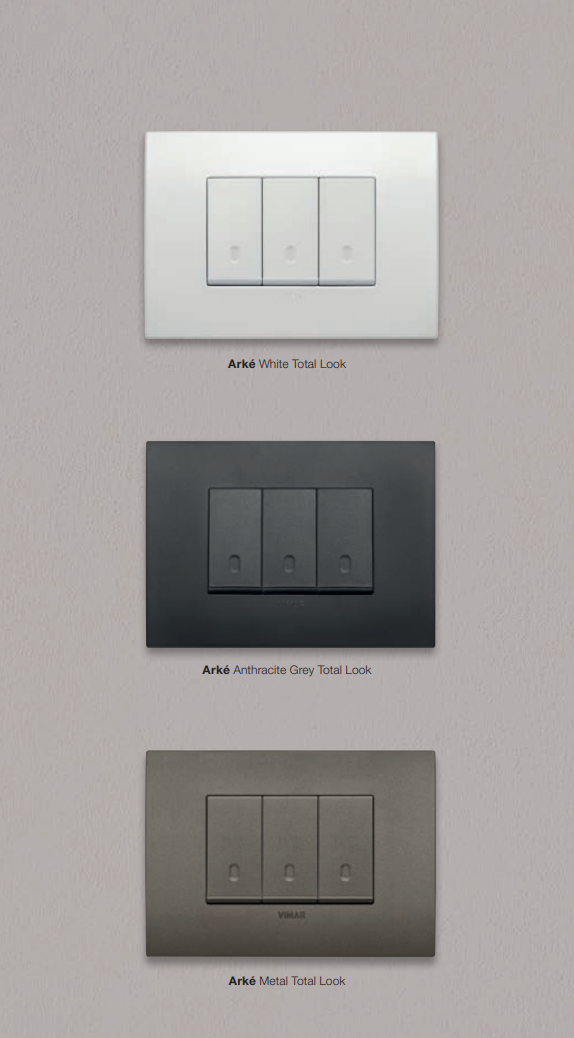
Arké: Plana, evolved
Installers call Arké "Plana, evolved". Arké's catalogue summary confirms two design lines, Arké Classic (a rigorous, linear shape) and Arké Round (a soft, sinuous one), plus matt finishes such as graphite, slate, titanium and pearl. It also confirms By-me compatibility. My slide said it works equally well with traditional wiring and KNX devices. I could not confirm the KNX part. It is my default when the client has not chosen a look.
Idea: the workhorse
Classic, reliable and very modular. Vimar's customisation brochure lists 12-module and 18-module Idea plates (Vimar depliant), which supports the 18 I quoted. Rear fixing is its quirk. It is the right choice when you extend a property that already has Idea: match the family and never introduce a second one. It sits roughly where Bticino Living International sits, and it is popular in marine fit-outs.
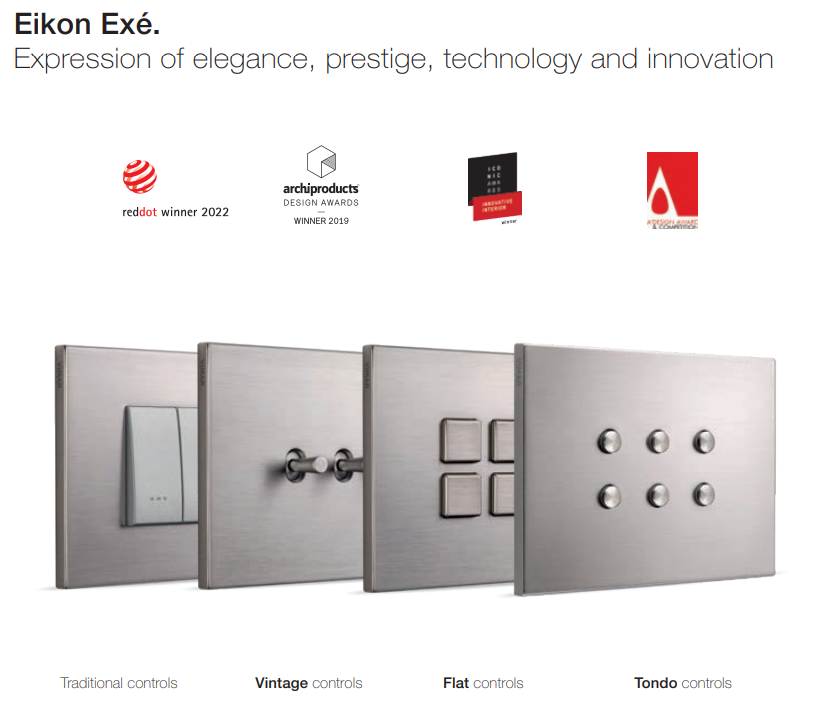
Eikon, with Evo and Exé: the flagship
Materials are where Eikon wins. Vimar's Eikon Exé page lists glass, leather, mirrors, wood, metals and marbled stoneware, and says the buttons can be laser-engraved with icons and pictograms. The British Standard catalogue mentions metal, solid wood, natural stone, crystal, stainless steel and technopolymer for Eikon.
Linea: the newest
Ultra-thin and aimed at smart installations, according to my slides. This is the family where my slides outran what I could verify. The catalogue summary I found (Linea) confirms rear terminals for cables from 0.75 to 4 mm² and shuttered socket contacts. It does not mention the British Standard version with USB sockets or the German/French plates with Smartfix terminals. Those may well exist. Verify the exact part before quoting.
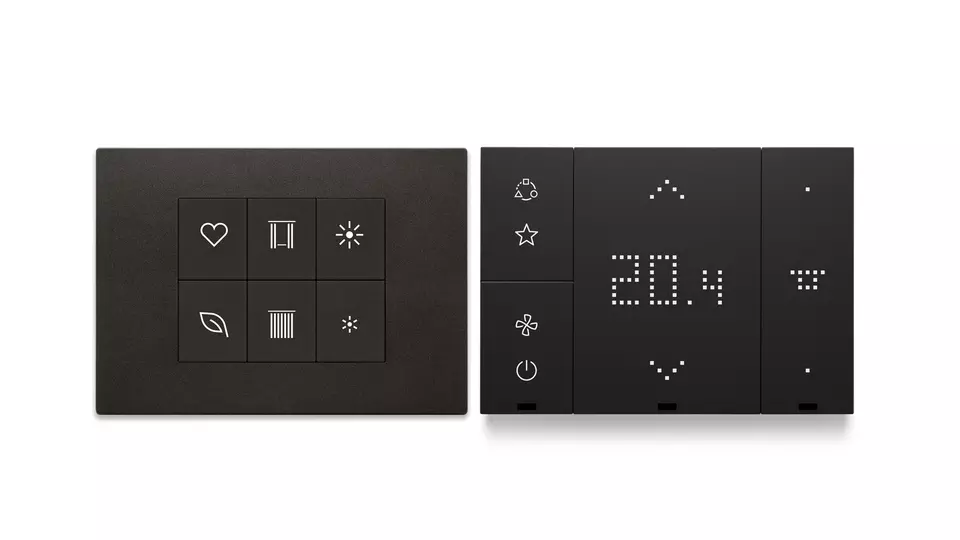
The cheat sheet
When a client or architect already has a Bticino specification, this is the fastest way to translate it: Plana for Light, Idea for Living International, Eikon for Axolute. Arké sits between Light and Living, and Linea has no Bticino
equivalent in my table.
Why Eikon stays in its own lane
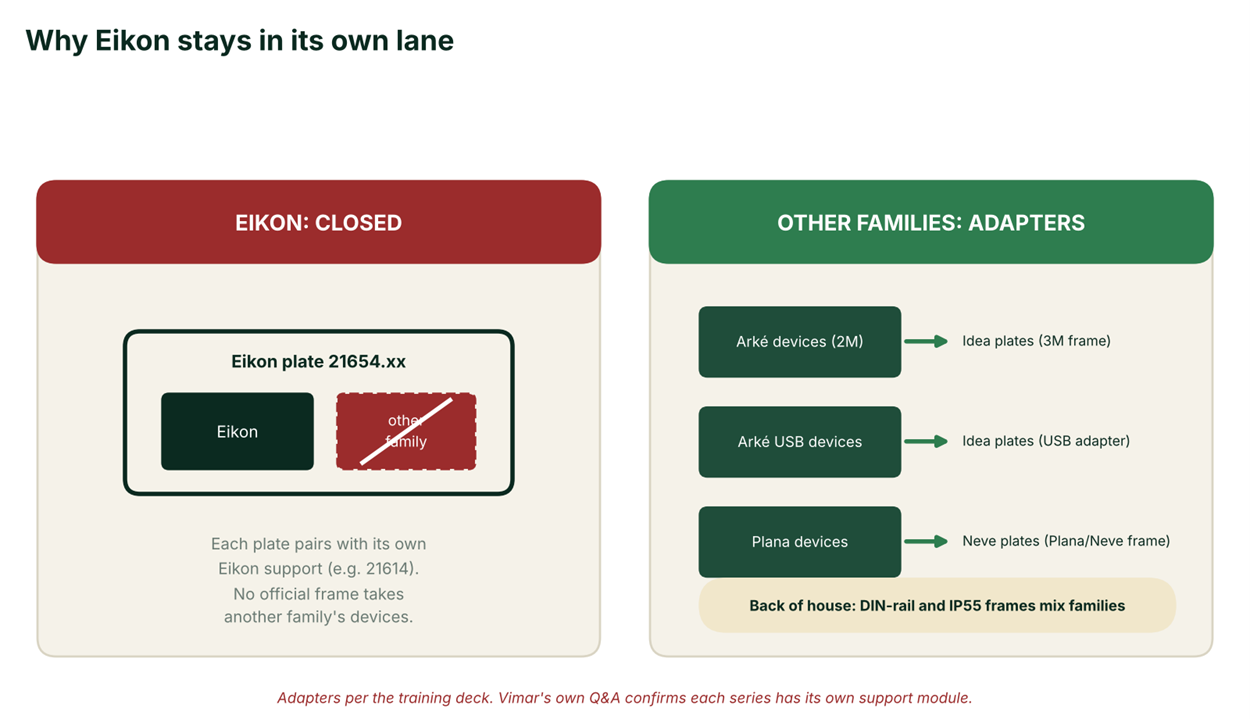
Not every family boundary is equally strict. Eikon is the strictest.
Each Eikon plate pairs with its own Eikon support code. My slide gave plate 21654.xx with support 21614 as the example. I could not fetch those two product pages, so treat the example as unverified. What I could confirm is Vimar's own product Q&A (product 21613.C): when a customer asked whether an Eikon plate fits an Eikon Evo support, the answer was no, because each series has its own support module with corresponding plates.
The practical result matches what I taught. Once a client commits to Eikon plates, every device on that wall is Eikon too. There is no swapping in a cheaper Plana dimmer later to save money.
Other families
are more forgiving, according to my slides: a 3M Arké/Idea frame lets two-module Arké devices sit under Idea plates, an Idea-Arké USB adapter gives Idea installations USB charging that Idea never had, and a Plana/Neve frame lets Plana devices sit under Neve plates. I could not find those adapters in the pages I read, so confirm part numbers before quoting. The same product page does show a cover for a shared 3M frame for Eikon, Arké and Plana, which tells you the families share some hardware.
The exclusivity is about the visible plate, not the electronics. In a distribution board or IP55 utility box, there is no decorative plate to match.
Monoblock: a different philosophy
Sometimes the right answer is no modularity at all. A monoblock device moulds the device, frame and cover as one piece. There is no plate to choose and no frame to align.
Vimar's Mascot series in the 1960s is the historic reference. Today's monoblock products live mostly in utility, industrial, marine and exterior or weatherproof settings, not in the Plana, Arké, Idea, Eikon and Linea families.
Use it for utility and back-of-house circuits, exterior or weatherproof points, and budget-driven scopes nobody sees. Avoid it when the client cares about a coordinated finish or the fittings are on show. Check the live Vimar catalogue for the exact product code before pricing. I flagged that in my own notes too.
Choosing a family: six questions
Before you name a family, ask:
What is the budget band: entry, mid or flagship?
New installation, or an extension of an existing Vimar system?
Does the client want colour or material customisation, such as RAL matching or engraving?
Will devices need servicing or swapping later, so does front fixing matter?
Is this a showcase space or a back-of-house area?
Which national standard do the boxes need? Almost always BS here.
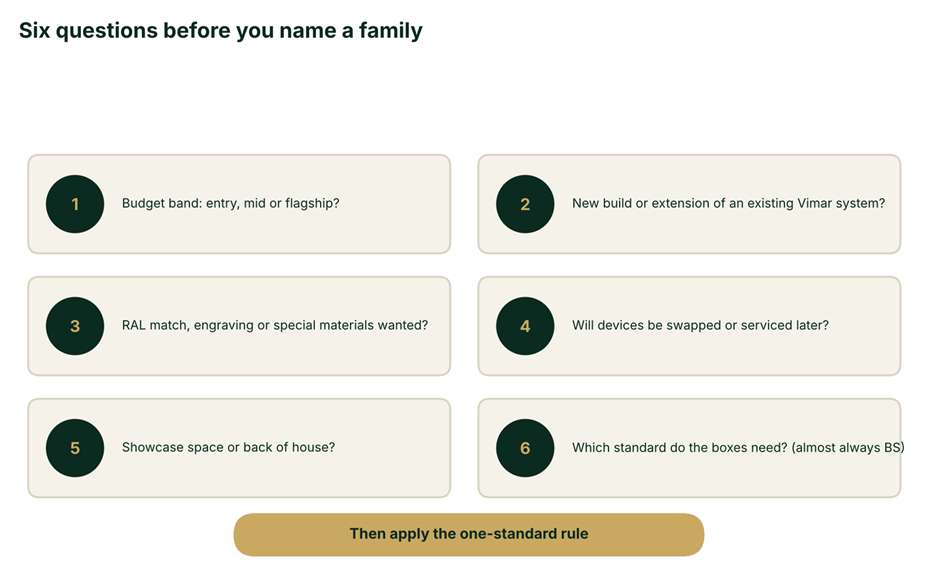
Then apply the one-standard rule.
Scenario practice
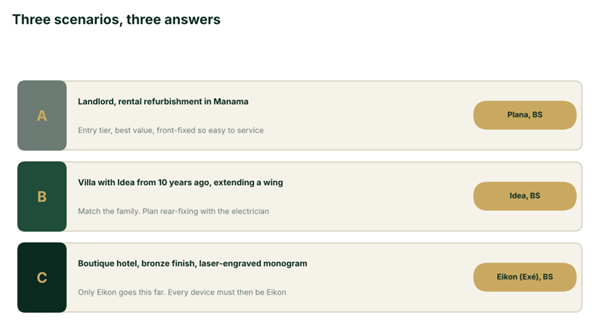
I gave the team three briefs. Here are the answers we landed on.
A. A budget-conscious landlord refurbishing a rental apartment in Manama between tenants. Plana, British Standard. Entry tier, best value, front-fixed so it is easy to service later.
B. A villa already fitted with Vimar Idea ten years ago, with the owner extending one wing. Idea, British Standard. The new points must match the old ones. Plan Idea's rear-fixing sequence with the electrician.
C. A boutique hotel lobby and suites, with a bespoke bronze finish and the hotel monogram laser-engraved on every plate. Eikon (Exé), British Standard. Only Eikon goes this far, and remember that every device on those lines must then be Eikon too.
Key takeaways
Every Vimar point is four parts in order: box, frame, device, plate.
The frame does the real work.
Fixing is front (Plana, Arké, Eikon) or rear (Idea).
Vimar sells the same devices in three standards, and almost every Essentia project needs British Standard.•
One standard for the whole house.
In Bahrain, BS unless a big function forces Italian.
Plana, Arké, Idea, Eikon and Linea are tiers, not colours. Match the tier to the budget and the brief.
Eikon's plate-to-support pairing is closed. Commit to Eikon plates and every device is Eikon.
Monoblock trades flexibility for simplicity. Right for utility and exterior points, wrong where the finish shows.
Sources
Vimar: Relive our timeline
Vimar: Historic Brand of National Interest
Vimar: 1 May 1945 to 1 May 2005 (60th anniversary)
Vimar: Eikon Exé
Vimar British Standard catalogue (ArchiExpo excerpt)
Vimar Arké catalogue (ArchiExpo)
Vimar Linea catalogue (ArchiExpo)
Vimar standard customisation depliant (PDF)
• Essentia Lighting & Control, Day 2 training deck (Vimar Deep Dive)
Sources
Downloads
- PPTDay2_Vimar_Deep_Dive.pptx94 KB
Comments
Be the first to comment.
Questions about this article
What are the four parts of a Vimar wiring point?
Every Vimar point is built in this order: mounting box, mounting frame, device or module, and cover plate. The frame does the real work, while the plate is purely aesthetic and snaps on last.
Which Vimar standard does Bahrain need: Italian, German/French or British?
In Bahrain the default is the British Standard (BS), as the Gulf states use the BS 1363 plug. Almost every Essentia quote needs the BS version of whichever family the client picks.
Can I mix Italian and British standard devices in one house?
No. Whatever standard you start with, the whole house follows it, because the wall boxes have different shapes and the plates will never sit square.
When would Italian standard make sense in Bahrain?
Only when a big function demands it. Italian frames go much wider than BS, up to 21 modules on an Eikon composition, which allows a wall of push buttons no BS plate can hold. In that case the entire house goes Italian.
What are the five Vimar families, and are they just colours?
They are Plana, Arké, Idea, Eikon and Linea. They are tiers, not colours, so you match the tier to the budget and the brief.
Which Vimar family suits a budget-conscious rental apartment?
Plana in British Standard. It is the entry tier with the best value, and it is front-fixed so it is easy to service later.
What is the difference between front fixing and rear fixing?
With front fixing (Plana, Arké, Eikon), devices click in from the front and can be swapped without removing the frame. With rear fixing (Idea), devices go in from behind, so swapping later usually means pulling the frame.
My villa already has Vimar Idea. What should I use for the extension?
Stay with Idea in British Standard so the new points match the old ones, and never introduce a second family. Plan Idea's rear-fixing sequence with the electrician.
Can I put a cheaper Plana device under Eikon plates?
No. Each Eikon plate pairs with its own Eikon support, so once you commit to Eikon plates, every device on that wall must be Eikon too.
Which family allows custom finishes and laser-engraved plates?
Eikon, the flagship. Eikon Exé offers materials like glass, leather, mirrors, wood, metals and marbled stoneware, with buttons laser-engraved with icons and pictograms.
What is a monoblock device and where should it be used?
A monoblock moulds the device, frame and cover as one piece, so there is no plate to choose. It suits utility, back-of-house, exterior or weatherproof points, but not places where the finish is on show.
How do I translate a Bticino specification into Vimar?
Plana matches Light, Idea matches Living International, and Eikon matches Axolute. Arké sits between Light and Living, and Linea has no Bticino equivalent in the table.
Planning a project?
Talk to our engineers about lighting, control and automation for your space.