Home Automation Fundamentals - Intro
 Moaath Al-Bukaai17 Oct 2026 · 8 min read
Why the Cable Follows the Protocol: What I Taught Our Pre-Sales Team About KNX, DALI and the Rest
Last month I ran a three-day training for about ten of our pre-sales engineers at Essentia. Day one was protocols. Not because protocols are exciting, but because the protocol is the first decision a pre-sales engineer makes, and it is the one decision you cannot undo once the walls are closed.
This is the first of three posts from that training. The second covers Vimar's wiring device families and the third compares three DALI device makers. All three are written for integrators and engineers, not for homeowners.
…
The mistake that kills a proposal
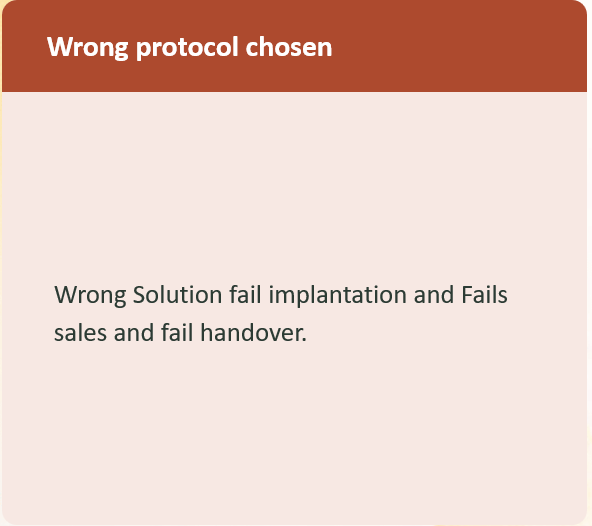
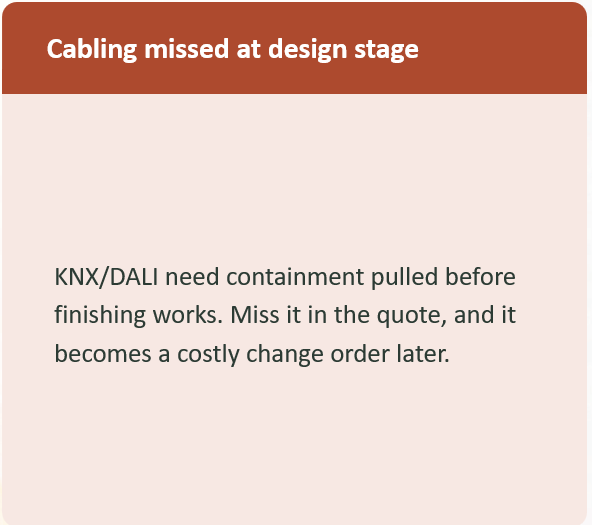
Here is how I explained it to the team. A proposal does not fail because the client did not like the keypad. It fails because the pre-sales engineer picked the wrong protocol, and the cabling on site follows that protocol.
Think about two clients.
The first one only wants lighting control. No AC, no curtains, no energy management. For him, KNX is overkill. DALI is cheaper, more practical, and the cabling is simpler. So you design the site around DALI cabling.
The second one wants lighting, AC, curtains and energy monitoring. He needs a building bus. If someone already wired his site for DALI only, you are stuck. DALI cannot drive his AC and curtains, and KNX devices cannot sit on his DALI cable. Neither protocol can save that site without opening walls again.
That is the whole lesson of day one. Match the protocol to what the client actually needs, before the electrical contractor finalizes his drawings, because the cable goes in at first fix and never comes out.
Where each protocol came from
I always start from origin, because the origin tells you what a protocol is good at.
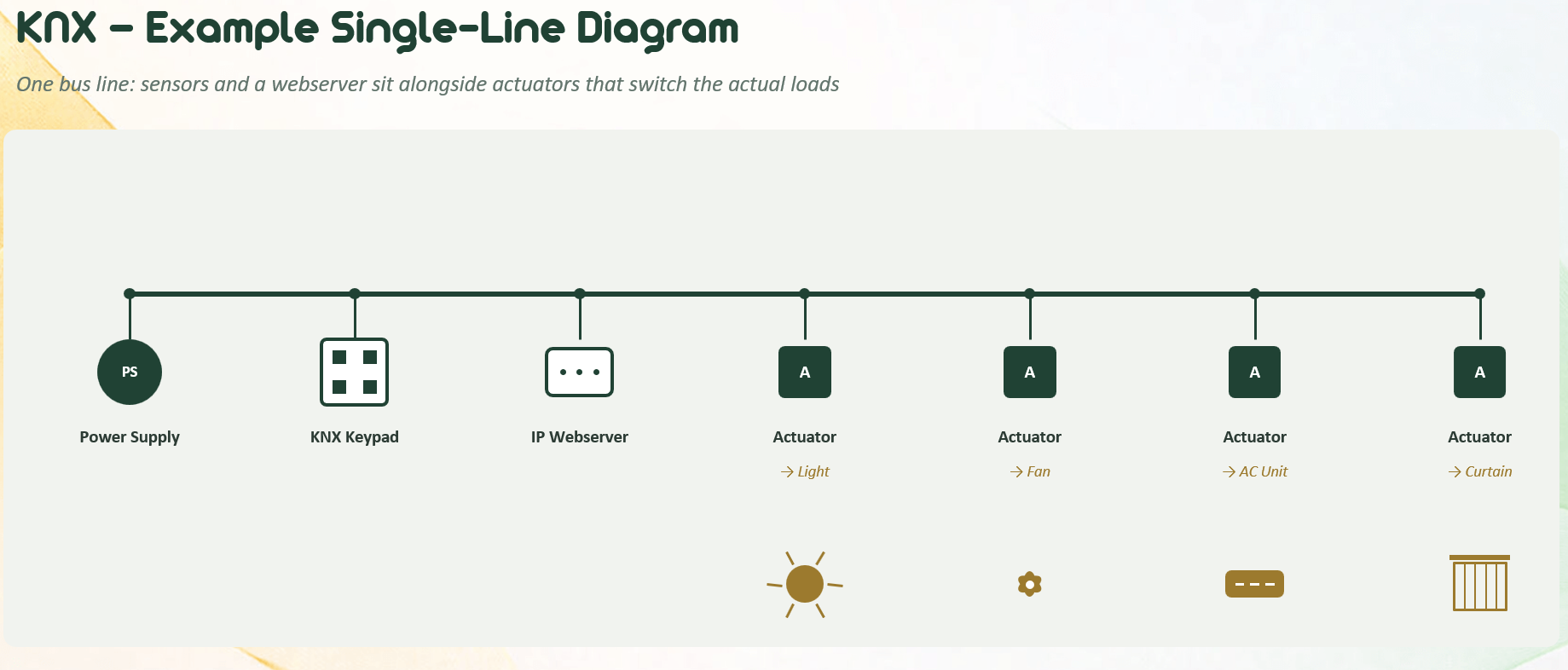
KNX was born in 1990 as EIB, built by European electrical manufacturers who wanted their products to work together. It merged with Batibus and EHS in 1999 and became an international standard (ISO/IEC 14543-3, EN 50090). It is a decentralized bus: every sensor and actuator carries its own logic, so if the server dies, the wall switches keep working. It runs on twisted pair, IP or RF, and everything from 500+ manufacturers is programmed with one tool, ETS.
KNX Association, KNX basics and topology (the 64/256 devices, 350/700/1000 m figures): https://www.knx.org/knx-en/for-professionals/index.php
DALI came from the lighting side. In the late 1990s the ballast makers (Tridonic, Philips, Osram, Helvar) needed a digital replacement for 0-10V dimming, which could only dim a whole group together with no feedback. DALI gave every driver its own address and let it report back. It became IEC 62386, and DALI-2 in 2014 added certified keypads and sensors so different brands finally talk properly.
DALI Alliance, what DALI is and DALI-2: https://www.dali-alliance.org/dali/ and https://www.dali-alliance.org/dali2/
DALI Alliance, DALI+ overview: https://www.dali-alliance.org/daliplus/
Other ways to control that need to be understood
0-10V is the thing DALI replaced. One control pair, every fixture on it dims together, no addressing, no feedback. Still fine for one simple dimmed zone on a tight budget.
ELV and relay is the conventional baseline. Push button, relay, done. Every project still has it somewhere: garden, utility rooms, back of house.
DMX512 is from the theatre world (1986). Fast, one direction, 512 channels, strictly in-line wiring with a terminator at each end. It belongs on façades, pools and colour effects, not on everyday room lighting.
On the wireless side: Zigbee and Z-Wave are mesh networks for retrofit; Wi-Fi is already in every house but was never designed as an automation backbone; Bluetooth mesh is hub-free and short range. And Thread + Matter is where the consumer world is heading: Thread as the mesh, Matter as the shared language on top. And we should talk about them in details in the future
One thing you need to understand about each protocol: it consists of 3 parts
Medium: is What physical channel carries the signal? Example: twisted-pair cable, mains wiring, 2.4GHz radio, sub-GHz radio, control voltage...
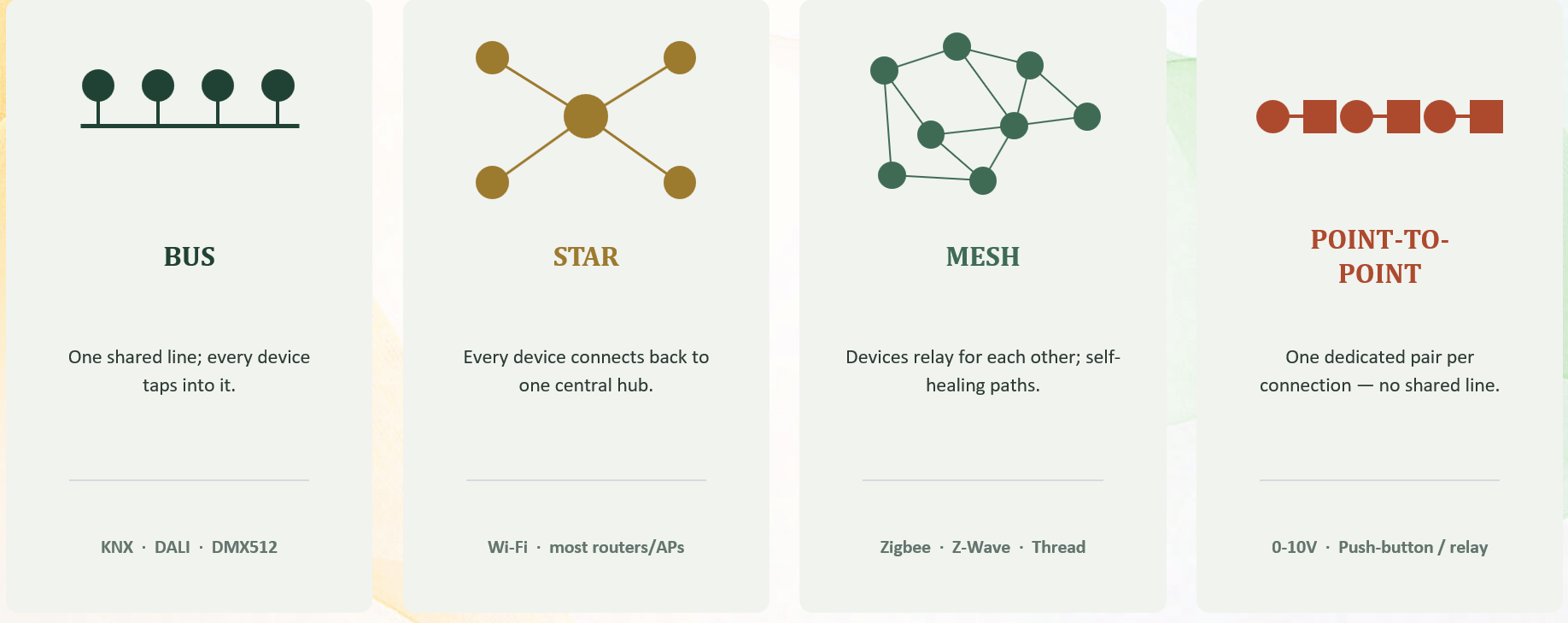
Topology: How are devices arranged and connected? Example: Bus, star, mesh, or point-to-point — covered on the next slide.
Addressing: How does a controller reach one specific device? Individual address, group address, broadcast, or no addressing at all (analog).
The three questions the team kept asking
Teaching this to ten engineers showed me where the real confusion sits. Not in the theory. In the cable and the numbers.
"What is the difference between KNX cable and DALI cable?"
This one took the longest. KNX uses its own certified bus cable: the green, halogen-free 2x2x0.8 mm cable, rated 300 V, with a red/black bus pair and a yellow/white spare pair. It comes in 1-pair and 2-pair versions and it has a polarity. DALI is the opposite. It runs on ordinary mains-rated electrical cable, two wires, no polarity. Reverse them and it still works. That single difference changes how the electrician prices and pulls the job.
"What is the difference between a group and a scene in DALI?"
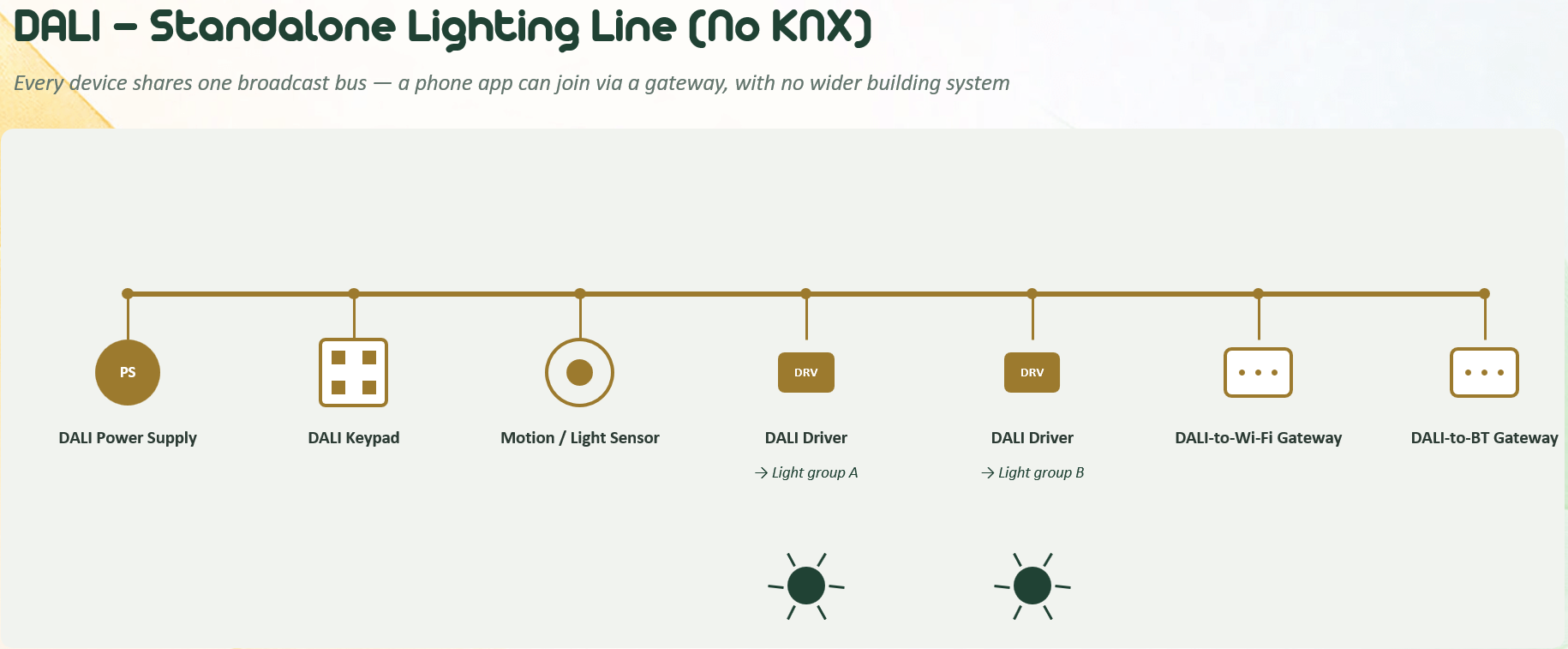
A group is who. You put fixtures 1 to 8 in group A, and the keypad talks to group A. A scene is what level. Scene 1 says group A at 100%, group B at 30%. One DALI line gives you 16 groups and 16 scenes. Groups organize the fixtures; scenes store the mood.
"Sixty-four devices? What if I need more? How do I link two lines?"
You do not link two DALI lines by joining the cable. Each line has its own power supply (exactly one, 250 mA maximum, unlike KNX which allows two on a line). To go past 64 addresses you add a second DALI line with its own supply and bridge the control through a gateway or a controller. On a KNX project, that gateway is usually the KNX-DALI gateway, and KNX handles the logic across all lines.
The numbers you must know before you quote
I drilled these because a pre-sales engineer who quotes without them will get the call from site.
| KNX | DALI |
Devices per line | 64 (up to 256 on newer TP1-256 lines) | 64 (control gear and control devices share the limit) |
Power supplies per line | Up to 2 | Exactly 1 |
Bus current | ~10 mA per device, 640 or 1280 mA supplies | ~2 mA per device, 250 mA max |
Cable length | 350 m supply to device, 1000 m per line | ~300 m at 1.5 mm², 2 V max drop |
Wiring shape | Line, star or tree, no loops | Line, star or tree, no loops |
Cable | Certified KNX bus cable, polarity | Ordinary mains cable, no polarity |
Modbus and DMX512 are the exceptions on wiring shape: strictly in-line, with termination resistors.
Wired or wireless, honestly
Wired buys you reliability, security and decades of service. It costs more upfront, it has to be designed in from day one, and moving a keypad later means pulling cable.
Wireless wins on retrofit speed and budget. It loses on interference (Zigbee, Wi-Fi and Bluetooth all share 2.4 GHz), on battery maintenance, and on wall penetration in the concrete and block construction we have in Bahrain. Z-Wave sits below 1 GHz and penetrates better, but check regional frequency certification for the GCC before you quote it.
Matter is interesting but not ready for our kind of work. Versions 1.4 and 1.5 are out, basic on/off, dimming and colour temperature are standard, but scene and group synchronisation are still weak and there is nothing close to DALI DT8-level tunable white. Keep it in the conversation for "future proofing" and consumer devices. Do not sell it as the lighting backbone.
One thing worth watching: in March 2026 the DALI Alliance showed its first certified DALI+ bridge, carrying real DALI commands over Thread to talk to wired DALI gear. Wireless DALI is coming. It does not change a single design rule today.
My recommendation
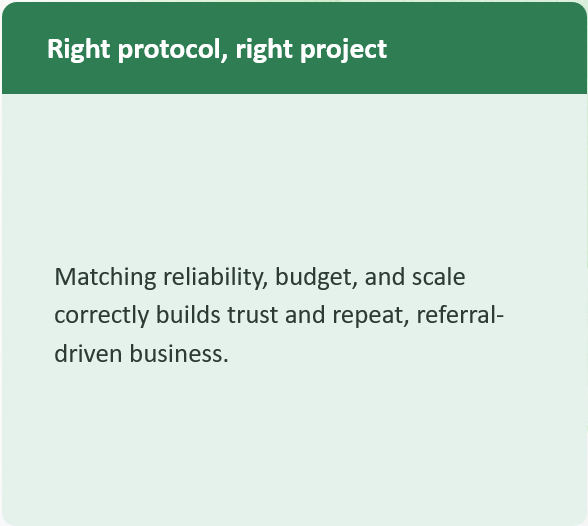
If the client wants lighting control only, however complex, go DALI and wire for DALI. If the client wants the whole house, go KNX for the backbone and keep DALI for the lighting layer behind a KNX-DALI gateway. That is the pattern behind most of our projects, and it gives you the best of both worlds.
If the walls are already closed and the budget is small, wireless is the honest answer. Say so.
And whatever you pick, pick it before the drawings are final. The cable follows the protocol. Nothing follows the cable.
Next in the series: five Vimar families and the one rule that matters in Bahrain.
Zennio KNX cable datasheet (green 2x2x0.8 mm, 300 V, red/black and yellow/white pairs): https://smtp.zennio.com/download/datasheet_cable_knx_en
EdisonReport, 17 March 2026, DALI Alliance growth and new certifications (first certified DALI+ bridge, 470+ members): https://edisonreport.com/2026/03/17/dali-alliance-reports-growth-and-new-certifications-at-light-building/
DALI Alliance press release, Light + Building 2026 (DALI+ with Thread): https://dali-alliance.org/data/downloadables/4/7/3/dali-alliance-at-light-build-2026.pdf
MatterAlpha, January 2026, Matter 1.4/1.5 state and lighting limits: https://www.matteralpha.com/explainer/most-anticipated-matter-features-and-devices-in-2026
Standards references the Day 1 deck itself was built on (cited in the slide notes, not re-fetched today)
DALI Alliance, what DALI is and DALI-2: https://www.dali-alliance.org/dali/ and https://www.dali-alliance.org/dali2/
DALI Alliance, DALI+ overview: https://www.dali-alliance.org/daliplus/
KNX Association, KNX basics and topology (the 64/256 devices, 350/700/1000 m figures): https://www.knx.org/knx-en/for-professionals/index.php
Sources
Downloads
- PDFDay1_Home_Automation_Protocolsv2.pdf692 KB
Comments
Be the first to comment.
Questions about this article
Why does the protocol need to be chosen before the electrical drawings are final?
The cabling on site follows the protocol, and the cable goes in at first fix and never comes out. If the wrong protocol is wired, neither KNX nor DALI can fix the site without opening the walls again.
Should I choose KNX or DALI for my project?
If you only want lighting control, however complex, go DALI and wire for DALI. If you want the whole house (lighting, AC, curtains, energy monitoring), use KNX as the backbone and keep DALI for the lighting layer behind a KNX-DALI gateway.
What is the difference between KNX cable and DALI cable?
KNX uses its own certified green, halogen-free bus cable (2x2x0.8 mm, 300 V) and it has polarity. DALI runs on ordinary mains-rated cable with two wires and no polarity, so reversing them still works.
What is the difference between a group and a scene in DALI?
A group defines which fixtures are controlled together, while a scene stores the level for each group, such as group A at 100% and group B at 30%. One DALI line gives you 16 groups and 16 scenes.
What if I need more than 64 devices on a DALI system?
You do not join two DALI lines by connecting the cable. Add a second DALI line with its own power supply and bridge the control through a gateway or controller, usually a KNX-DALI gateway on a KNX project.
Planning a project?
Talk to our engineers about lighting, control and automation for your space.